
The Illusion of Progress
Progress comes at a cost
Freedom isn’t free
If you want to make an omelet you have to crack some eggs.
Modernity requires the relinquishing of lifestyles that have been part of the human experience for all of recored history begging the big question is if the juice is worth the squeeze?
History is studied, cited and taught to give our current status quo context. This context is often invoked to justify the cost of modernity. Everything from our religious beliefs, to our governmental structure and our economy exist within a carefully constructed framework of “consensus narratives” which pacify the masses into compliance with the larger “plan”.
The prevailing/mainstream narrative of history is a linear progression from the primitive “Stone Age” through the Bronze and Iron ages, towards the modern technological “Information Age”. This is referred to as a “progression” from a miserable existence battling for scraps to our current gleeful existence of abundunce. Any perceived downside to this progress can be justified by the fruits of modernity.
Pipelines criss cross our lands, high voltage power lines are strung above our heads, the water is pulled out from under our feet and we are told it is progress. Our environment is continually being polluted through accidental spills and intentional dumping, but it has to happen.. for progress. One of the new battles that is popping up all around Texas, as well as the whole world, are DATA centers. Which consume huge amounts of water and which require so much power that small nuclear reactors on site are proposed to power them. But rest assured that these DATA centers are for us… for progress.
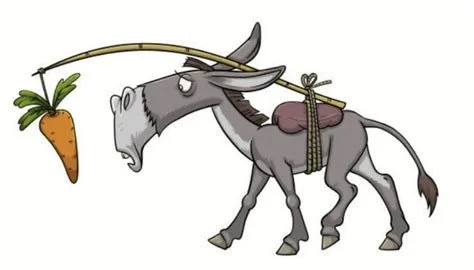
The dangling carrot of progress
This same type of Gaslighting has been used throughout the ages to send soldiers to war, justified slavery, and fueled countless other atrocities, many of which still continue today on an even larger scale.
This type of undermining is highlighted in the novel The Grapes of Wrath by John Steinbeck.
The Tractor passage highlights how the industrialization of modernity divorces humanity from the land. By commodifying nature’s resources and quantifing the once mystical experience of manually working and living on the land industrial farming boils the process down to chemistry and measures success by extracting the value from the land. The land is only as valuable because it produces a product. Once the people were pushed off the land the homes that house lives where replaced with shed that housed equipment, dead metal. The people who work the land no longer love the land as they work it, rather they hold it in contempt as just a job, they don’t reap sustenance from their labor, they reap money.
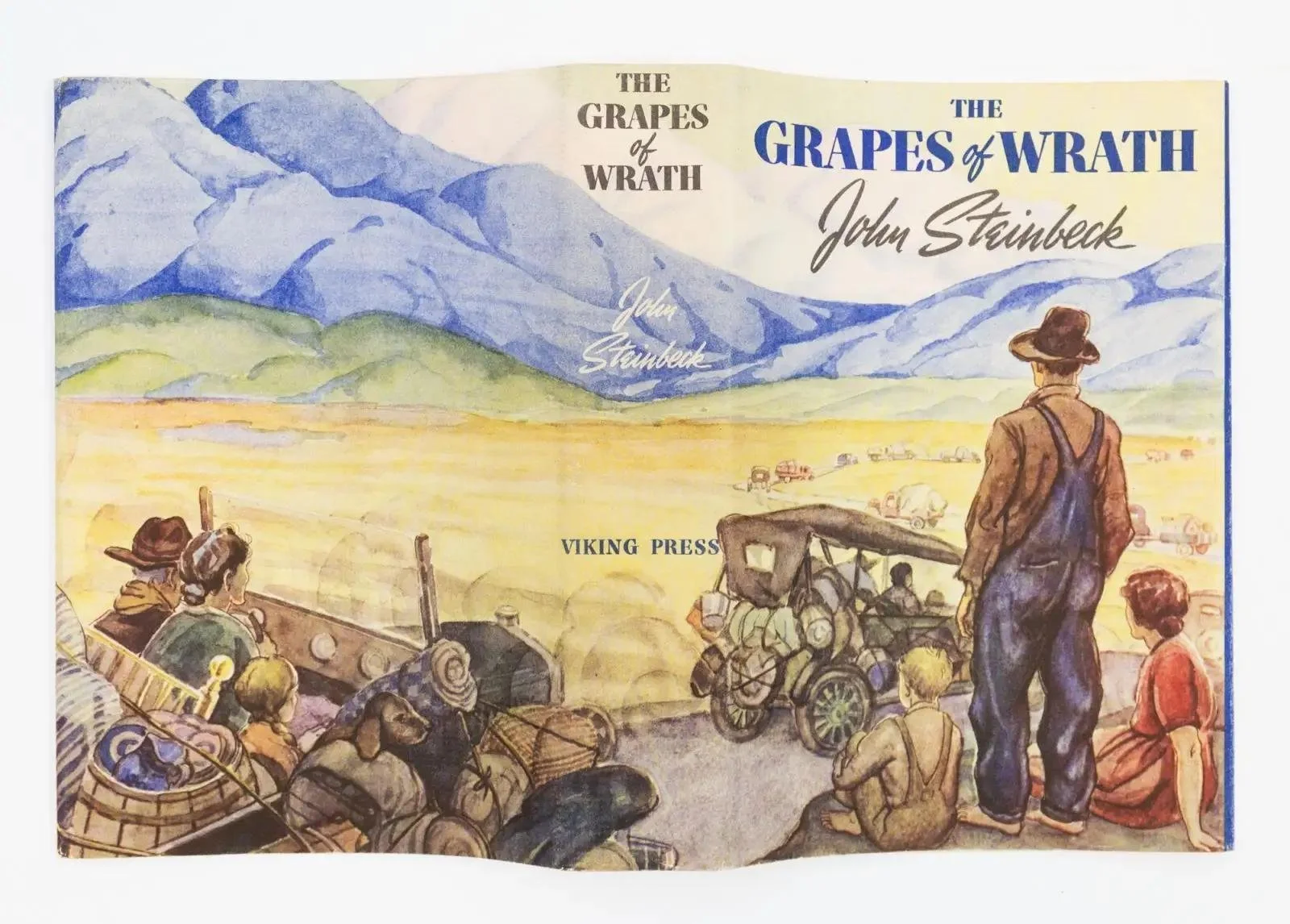
The Dust bowl, Economic crash, and industrialization all combined to destroyed a once Proud land owning farmer class of Agrarian Americans leaving in the ruins a nomadic class of farmer classified by the state as vagrants or “migrant” labor. They forced “Subsistence” farmers to switch to “Commodities” which required participation in financial entanglements forcing farmers to take loans out for next years crop. As industrialization dropped the “cost” of production for large businesses it made competition impossible for the “small scale COMMODITIES growers”. This allowed industrialist to control all forms of production by eliminating the compitition through market manipulation.
In the same way that the subsistence life style of the early “American” frontier was bulldozed for commodity farming the human soul is being harvested for DATA centers to be build. DATA Centers= SkyNet
They are building nuclear powered Computer centers that can be used to “store” and process DATA. We are being told it is to power the new AI revolution but I think that is bull shit. It is a new apparatus for commodifying the planet.
Projects like these receive millions of dollars in government AID, AKA YOUR tax money, Money that could be used for schools, given to farmers to grow clean food, given to the sick and dying to elevate suffering and improve the quality of what remaining life they have left….
No. billions of dollars for a project RUN BY A NUCLEAR REACTOR can use all our precious water to cool servers that process all of our information so that the billion dollar TECH company can better convince me to give them the rest of my money and the souls of Our children!
How Do You Free Yourself From a Prison You Can not See?
Using your eyes for the first time
We live in a propaganda machine that was built by the most proficient and genius magicians that have ever lived. Your thoughts are not your own. We justify atrocities because WE HAVE BEEN PROGRAMMED TO! It is not an accident that most people can’t point out the Middle East on a map, or explain taxation through the inflation of fiat money. This demonic system of explicit coercion exploits our collectivist nature using our very biology and cognitive development against us.
We must first admit that we have a problem. We are living in a society with advanced hardware and we are running cave man software. They know what they are doing to you, They are intensional in their attempt to create a victim or reliant hive minded mass. We must resist the urges of these digital demons and steer our selfs, our communities and lastly our society towards a spiritual revolution that will translate into the next enlightenment era of you social growth.
Cosmic Summit 2025 Recap
My wife thought I was a little crazy when I first told her I wanted to go to The Cosmic Summit 2025. “So you want to go to a Youtube convention..?” I had hesitated asking her but I wanted to go so I braved the beratement that I knew I would receive. She was right to be a little skeptical. The Cosmic Summit is aligned adjacent to the mainstream narrative around History. With presentation titles like “Annihilating Time and Space” and “The Shattered Evidence of a Suppressed history” it is easy to see grounds for skepticism. I was drawn to the conference because of specific presenters, namely Randall Carlson, of Kosmigraphia and JRE fame, Ben Van Kerkwyk from UnchartedX, Matt Beall of The Limitless podcast and possessor of a large collection of ancient stone vases and Bob Greenyer of The Martin-Fleischmann Memorial Project .
My world view has become very nuanced from watching and listening to hours of each of these presenters, amongst many more, and I really wanted the opportunity to shake hands and get some flesh and blood grounding to the presenters. It is very easy to get caught up in narratives and counter narratives, especially when placed in the algorithmic echo chamber of YouTube and various other social medias. Were these people just grifting as my wife believed? Were these people just fame chasing? or is it possible that our history is not as cut and dry as the modern mainstream narrative wants us to believe? I am going to hit the high notes from the conference and highlight some interesting information from the presentations I attended.
Randall Carlson
Randall Carlson
Randall Carlson was my, as many the alternative history community, gateway drug into the mindset of cataclysm, reset and the esoteric nature of symbology and myth.
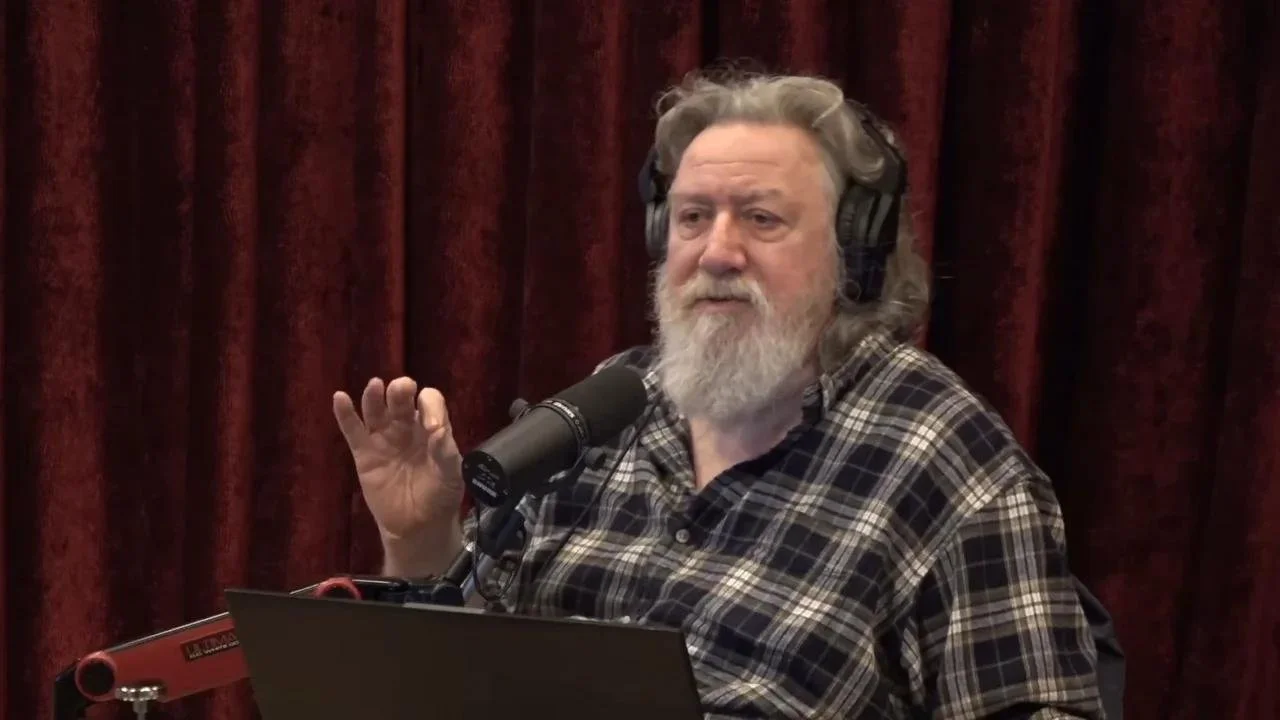
Randall Carlson on the Joe Rogan Experience
Randall’s presentation highlighted the geological remnants of cataclysmic water flows over the North American continent that were created durning the transition from the Pleistocene to the Holocene between 14,600-11,600YBP. Randall believes that the evidence put forth by The Comet Research Group points towards a cosmic impactor, Comet or Solar outburst.

Image from The Comet Research Group detailing their hypothesis
I got a quick moment to speak to Randall Carlson as he walked towards his room. I did feel bad because I could tell he was on the move trying to head towards bed. Got to give him my thanks for all the work he has put into the world. He is a huge advocate about how we can now, with projects like DART, affect the trajectory of an asteroid there by avoiding the “next” impact. I did take a quick second to ask him if he thought if we could make one not hit Earth, could an ancient actor have caused one TO hit Earth. This was a question directed more towards his symbolic work… slight side note, got to meet Randall’s wife in the food line and very much enjoyed talking to her.
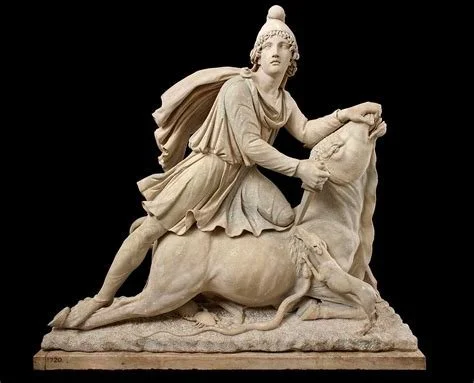
Mithras killing the bull
Ben Van Kerkwyk
Uncharted X
Ben Van Kerkwyk has played an integral role in popularizing the oddities and incongruent nature of mainstream explanations with the ancient evidence that exist. His numerous series on his YouTube Channel UNchartedX have pushed the conversation forward, his series on the precision of the ancient stone vases inspired Matt Beall to spend a small fortune procuring a huge collection of these objects, more on that in a minute. Ben’s presentation centered around The Great Labyrinth of Ancient Egypt.
WIKI definition: The Labyrinth of Egypt was a structure, or temple, built south of Amenemhat III's pyramid at Hawara. Not much is known about its use, but it was probably a multifunctional building—with a palace, town and administrative centre. Its complex layout reminded visitors in classical times of the legendary labyrinth of Minos at Knossos in Crete. The site has garnered interest throughout history, and contemporary excavations have unearthed artifacts from both Amenemhat's reign and the Roman era.
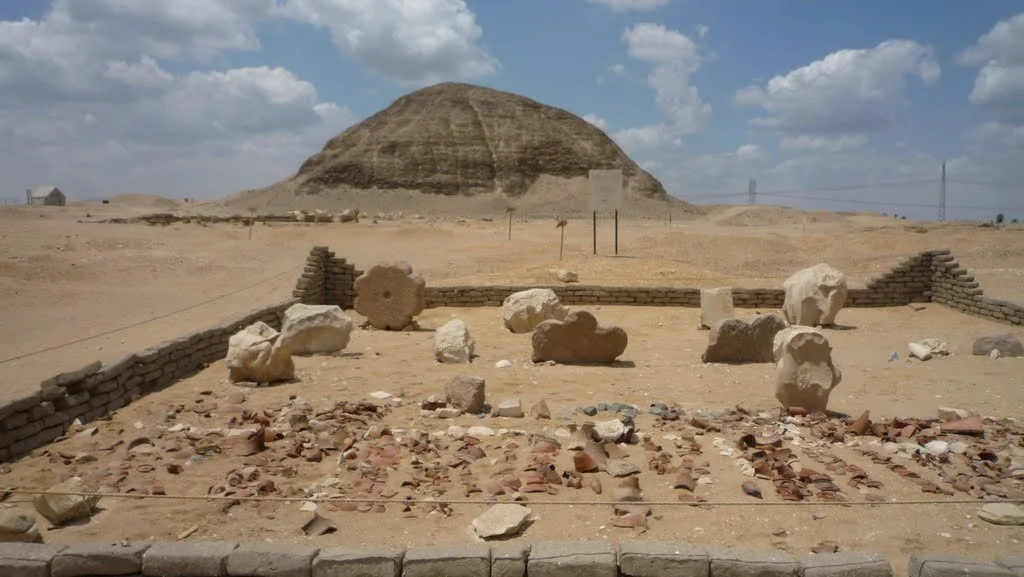
Pyramid of Harawa
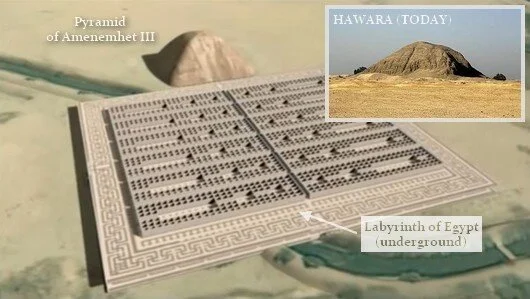
Estimated size of the maze

Image from Ben’s cosmic summit presentation

The Pyramid is knows as Amememhat 3’s. Many
Matt Beall
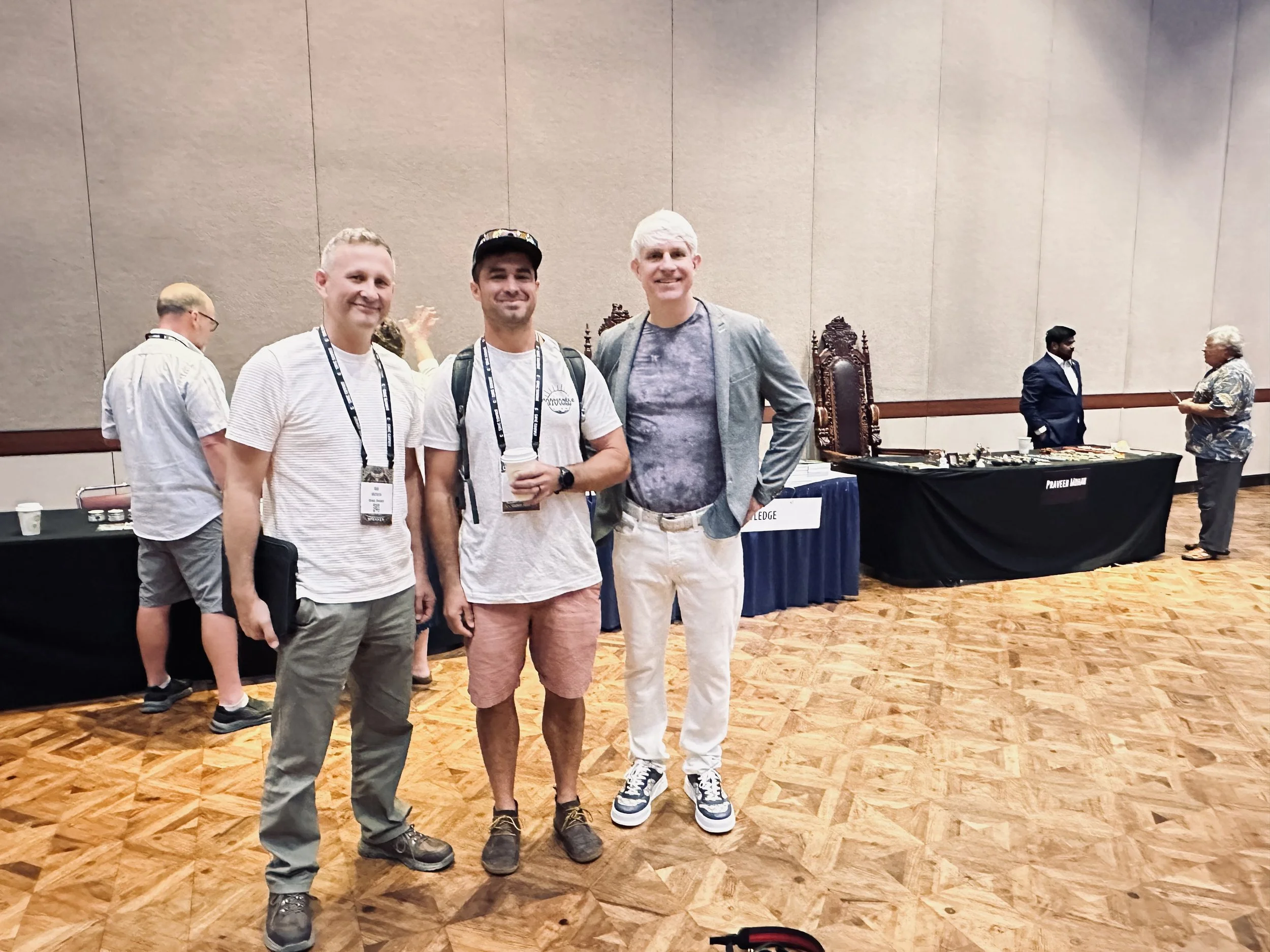
Bob Greenyer, Dexter Cearley, and Matt Beall at the Cosmic summit.
Two of the reasons I went to the Cosmic Summit 2025 are in the picture above. Bob Greenyer, of the Martin Fleischmann Memorial Project, and Matt Beall, CEO of the department store Beall’s, podcaster and possessor of one of the largest privately owned ancient Stone vase collections. I was lucky enough to get to speak to Matt, Matt’s lovely wife, Krystel Beall, and Bob for a little bit during the conference. Matt’s interview of Bob on his podcast The Matt Beall Limitless Podcast in amongst the best resources for an into into LENR(low energy nuclear reactions) or CET(Coherent Energy Transformation) however more on that shortly… Matt Beall presented on the main stage on the research that has been done on his and museum vases that add to the mystery surrounding the vases. As a bonus for the attendees of the conference Matt all allowed complete randos, like me, the opportunity to hold some of these objects.
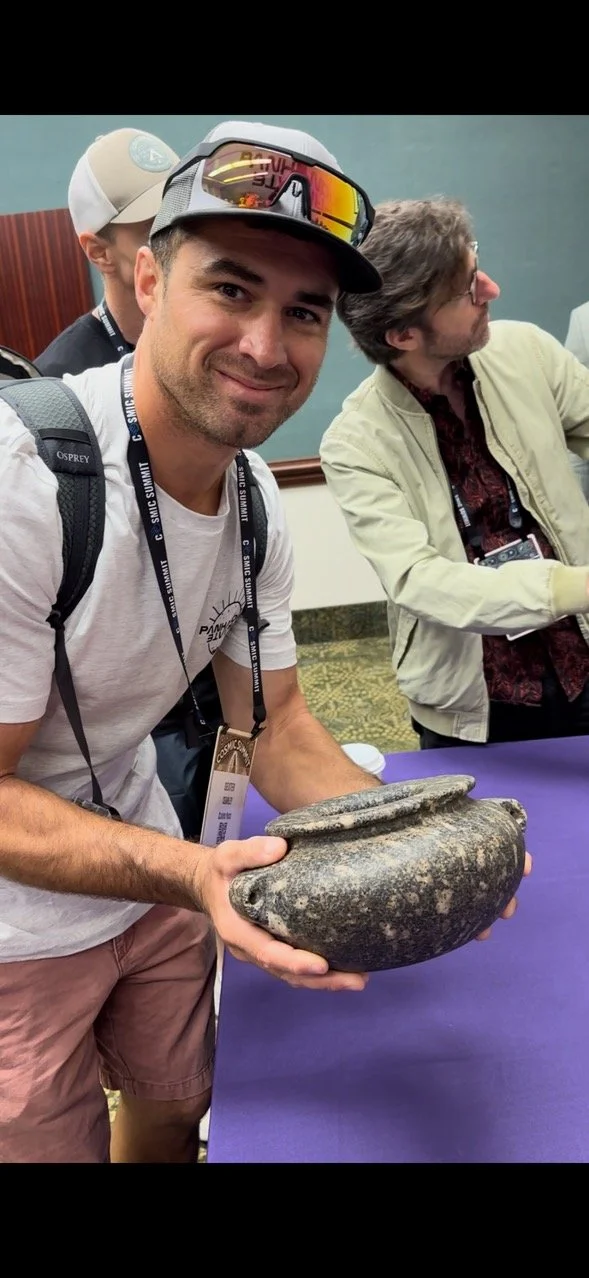
Dexter holding a priceless artifact.
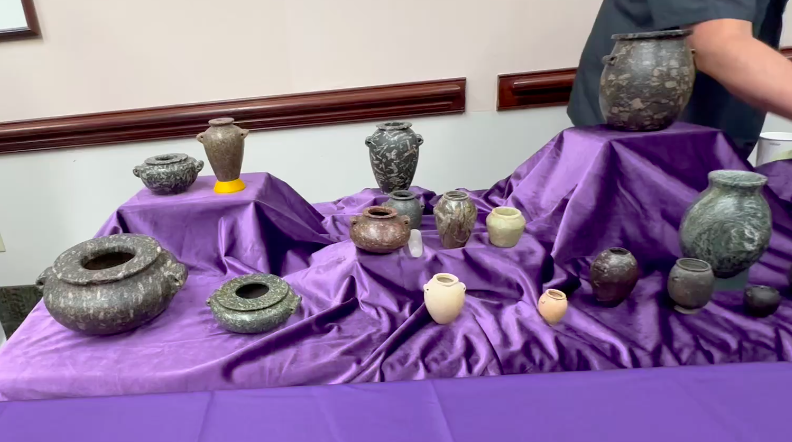
Various stone vases that Matt brought
The infamous spinner vase
Vase verified to the 1800’s with deep lip. Ben Van Kerkwyk of UnchartedX and Ryan Barthal
The key mysteries of the Vases, as pointed out by Matt, are When? Why? Who? and How? They do know that the vases date back to the at or before the 3rd dynasty 2686-2613BC. This is based off the fact that largest find of these vases were discovered under the pyramid of Djoser, where many discarded remnants cans still be found today.
A Different Type of Tech
I was first introduced to the concept of “the high water mark” of civilization by Dan Carlin, host of the Hardcore History Podcast. Carlin would weave the ebb and flow of civilization into his accounts of the past to show that civilization frequently collapses from grander and how within a few short generations knowledge and techniques of the previous high can be completely lost. This illustrates humanities ability to forget the past and become accustomed to the current standard of civilization as baseline. An example of this is growing up with the internet. To a digital native the internet seems mundane, or even harmful, but just 50 years ago the internet and all the devices that it operates through were considered science fiction and were dreamed of for the possible benefit to humanity. If society collapse today due to a global disaster how long before the survivors would be looking at the technological remnants that we use so ubiquitously today as magical devices built by gods?
It is with this lens that I want to present a few sites and artifacts from around the world that I believe exemplify a lost technology that modern people lack a frame of reference to conceptualize. Our historical and religious institutions are quick to label everything as a tomb, a church, or purpose some other ritualistic/symbolic meaning. The individuals who constructed many of the ancient megalithic sites around the world are believed to have been driven by mythological and egotistical motivations. We are meant to believe that, although these sites push the very limits of our technical understanding, both physically and logistically, the builders of the ancient past were slaves, illiterate, and/or freshly liberated from a subsistence hunter gatherer lifestyle who were motivated by a “god” king to build places of worship and burials that served no practical purpose. We are told these sites were commissioned by megalomaniacal egotistical royalty with the intention to remind the world of their greatness. This frames these marvels not as an achievement of humanity or an attribute of human potential, but as an example of the worst aspects of an individual’s ego or an expression of “false” religious fervor.
The question of how and why these sites were built is still largely excepted as a mystery. There are standard narrative explanations that fall far short of plausible when presented in fresh context.
Do you have the eye for it?
Arthur C. Clark was pivotal in the construction of the modern view of science and science fiction in popular culture. Clark is well known for his role in writing 2001: A Space Odyssey and was a proponent of space travel throughout the 20th century. He came up with a list of three laws which have served to help conceptualized the modern view of technology.
Arthur c. clark’s three laws
When a distinguished but elderly scientist states that something is possible, he is almost certainly right. When he states that something is impossible, he is very probably wrong.
The only way of discovering the limits of the possible is to venture a little way past them into the impossible.
Any sufficiently advanced technology is indistinguishable from magic.
Clark’s 3rd law is most often referred to by modern researchers when presenting the argument that the “Magical” abilities of the mythologized past might have just been advanced tech from a forgotten or erased civilization. It is in this context that we can begin to question the standard narrative, that was developed by “accredited” archeologist, and seeks to reimagine the purposes of some of earths most iconic and little understood archeology sites.
Unexplained Construction Techniques
The Unfinished Obelisk
The Unfinished obelisk in the Aswan Quary in Egypt has baffled onlookers since it’s “discovery” in the 1920’s. This obelisk, when finished, would have measured around 41.75 meters (137.0 ft) and would have weighed nearly 1,090 tonnes (1,200 short tons). The mainstream narrative for how the ancient Egyptians quarried this stone was by lighting fires on the surface and pouring water on the hot rock causing fracture lines, “drilling” holes and placing wood into the holes, then soaking the wood and as the wood swells causing breaks, and using diorite pounding stones to break and shape the rock although these are just theories. There are also theories about how these were transported with the leading theories involving man power and rolling the stone on logs and possibly using the same diorite pounding stones. Alternative theories purpose everything from stone softening with acids to some sort of machinery.
Mohs scale is used to define how hard/scratch resistant a material is. Copper, which is the tools that the Dynastic Egyptians were said to possess is a 3, with diorite and granite ranking 6-7.


THE STONES OF BAALBEK LEBANON
The standard narrative of Baalbek Lebanon is that around the beginning of the common era the Roman’s gained control of Baalbek and built the “temple of Jupiter” on top of or around an already existing “religious” site. The whole complex is attributed to the Romans even though there is no direct records of them building it. The Romans no doubt occupied the site and built there however what is in question is what, if anything was there before the Romans? Baalbek is most well known for 6 megalithic blocks, three blocks, known at the Trilithon, which are the largest blocks ever moved, and three blocks that are still in the quarry, which are three of the largest stones ever queried.
The Trilithon
The Trilithon, also called the Three Stones, is a group of three horizontally lying giant stones that form part of the podium of the Temple of Jupiter Baal at Baalbek. The location of the megalithic structures is atop a hill in the region known as Tel Baalbek. Each one of these stones is 19 metres (62 ft) long, 4.2 metres (14 ft) high, and 3.6 metres (12 ft) thick, and weighs around 750–800 tonnes (1,650,000–1,760,000 lb). The supporting stone layer beneath features a number of stones which weigh an estimated 350 tonnes (770,000 lb) and are 11 metres (36 ft) wide.


The stone of the PREGNANT lady
The Stone of the Pregnant Woman (Arabic: حجر الحبلي, romanized: Ḥajar el-Ḥible), also called the First Monolith, still lies in the ancient quarry at a distance of 900 metres (3,000 ft) from the Heliopolis temple complex.[9] Although the smallest of the three monoliths, it is also the most famous due to its fine condition, the imposing angle at which it lies, and it never having been fully hidden by the earth. According to their calculations, the block weighs 1,000 tonnes.

The Stone Of the south
The Stone of the South, also called the Second Monolith, was rediscovered in the same quarry in the 1990s. With its weight estimated at 1,242 tonnes (2,738,000 lb), it surpasses even the dimension of the Stone of the Pregnant Woman

the forgotten stone
The Forgotten Stone, also called the Third Monolith, was discovered in the same quarry in 2014 by archaeologists from the German Archaeological Institute. Its weight is estimated at around 1,500 tonnes (3,300,000 lb), making it the largest stone ever quarried. It is 19.6 metres (64 ft) long, 6 metres (20 ft) wide, and at least 5.5 metres (18 ft) high.

BaraBar Caves
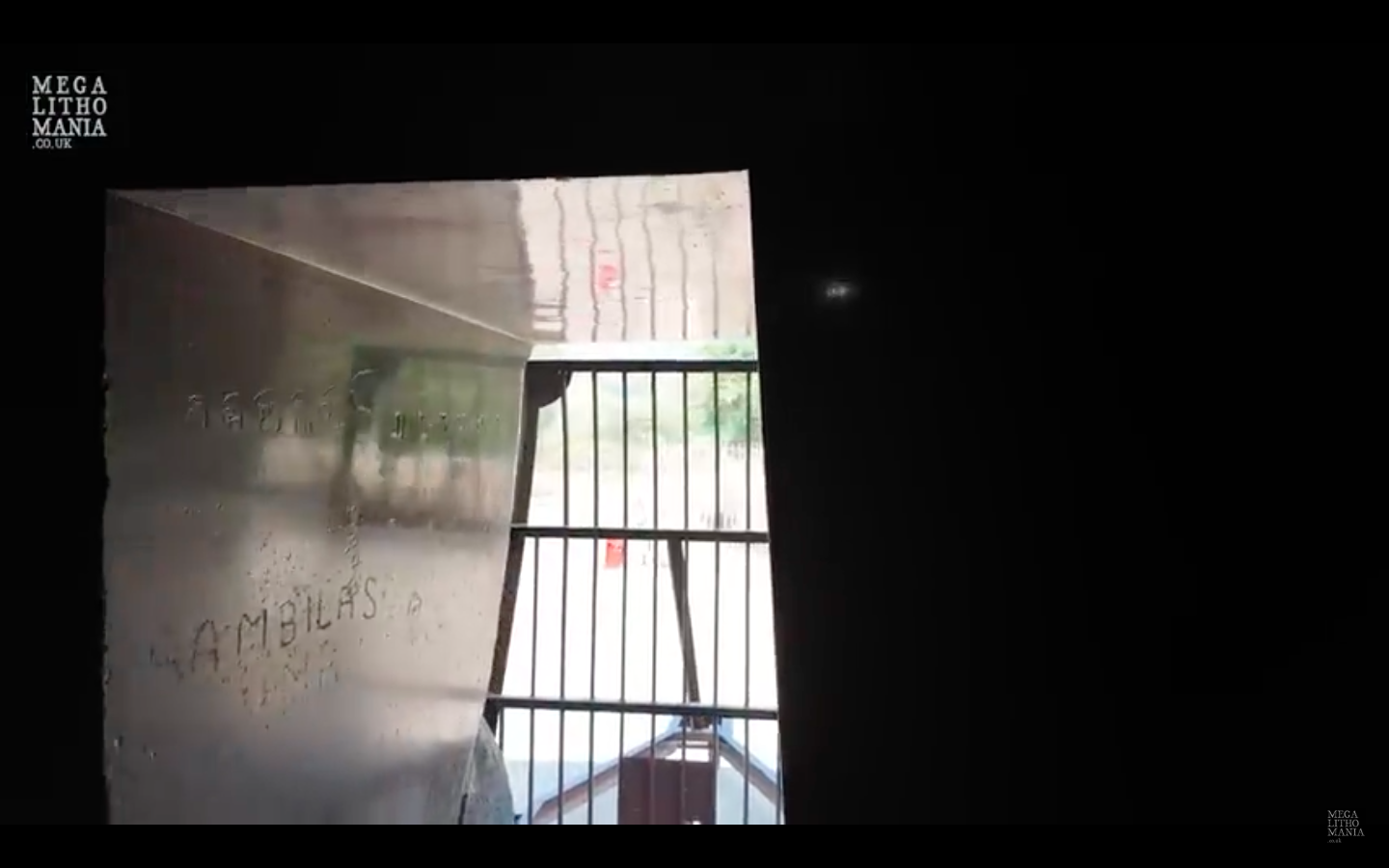
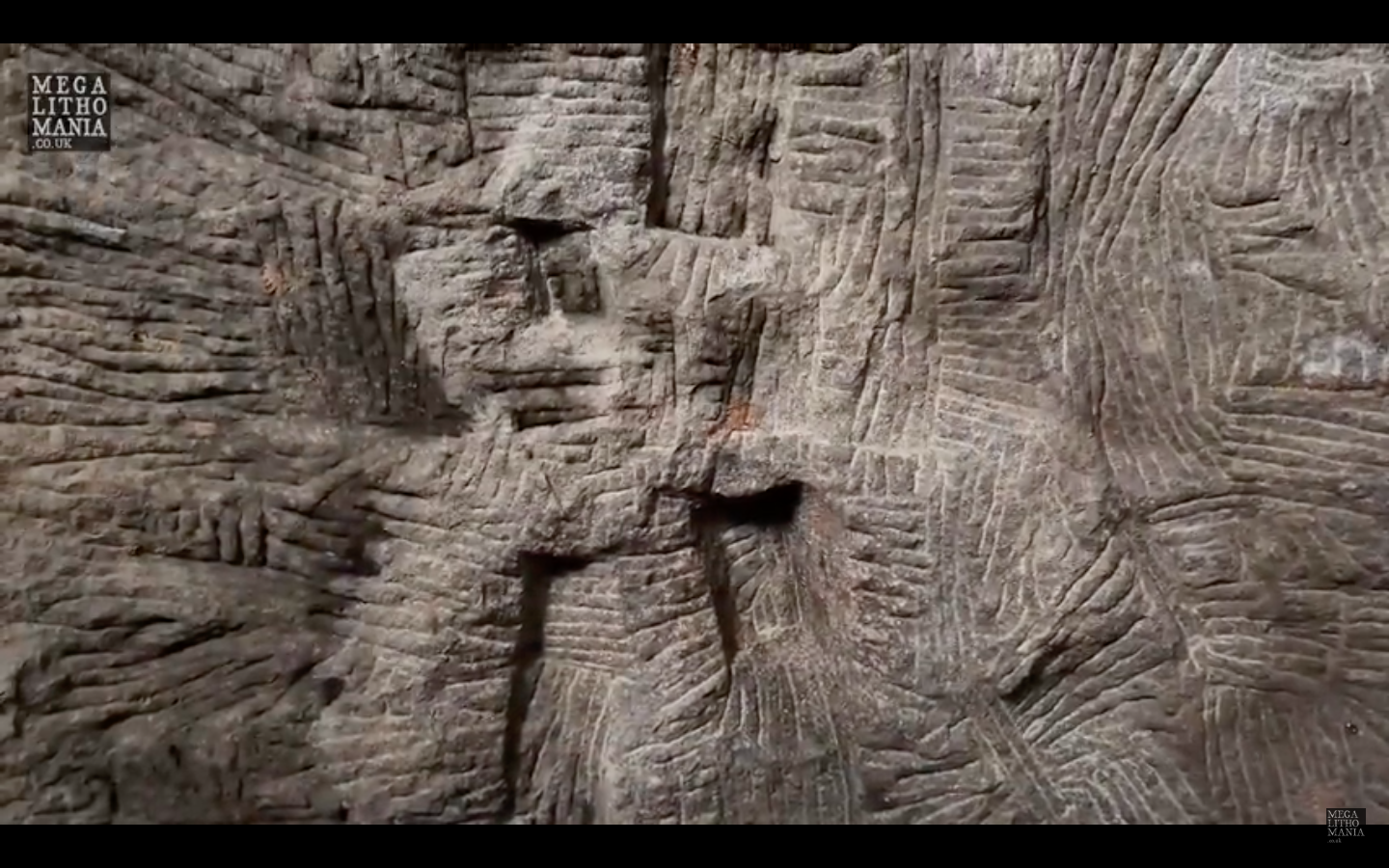
From WIKI: The Barabar Hill Caves are the oldest surviving rock-cut caves in India, dating from the Maurya Empire (322–185 BCE), some with Ashokan inscriptions, located in the Makhdumpur region of Jehanabad district, Bihar, India, 24 km (15 mi) north of Gaya.[1]
Photos pulled from the video entitled Barabar Cave Temples | The Impossible Precision of Ancient India | Megalithomania Documentary Part 1






Stone Boxes of the Serapeum
The Boxes in the Serapeum of Saqqara are a great example how the Standard archeological narrative breaks down in both explanation of how these sites were built, who built them and why. It is believed that the Apis cult is responsible for constructing the tunnel system and the first “Burial” boxes out of wood, it is believed that this was possibly founded by pharaoh Menes, around 3,000 BC.
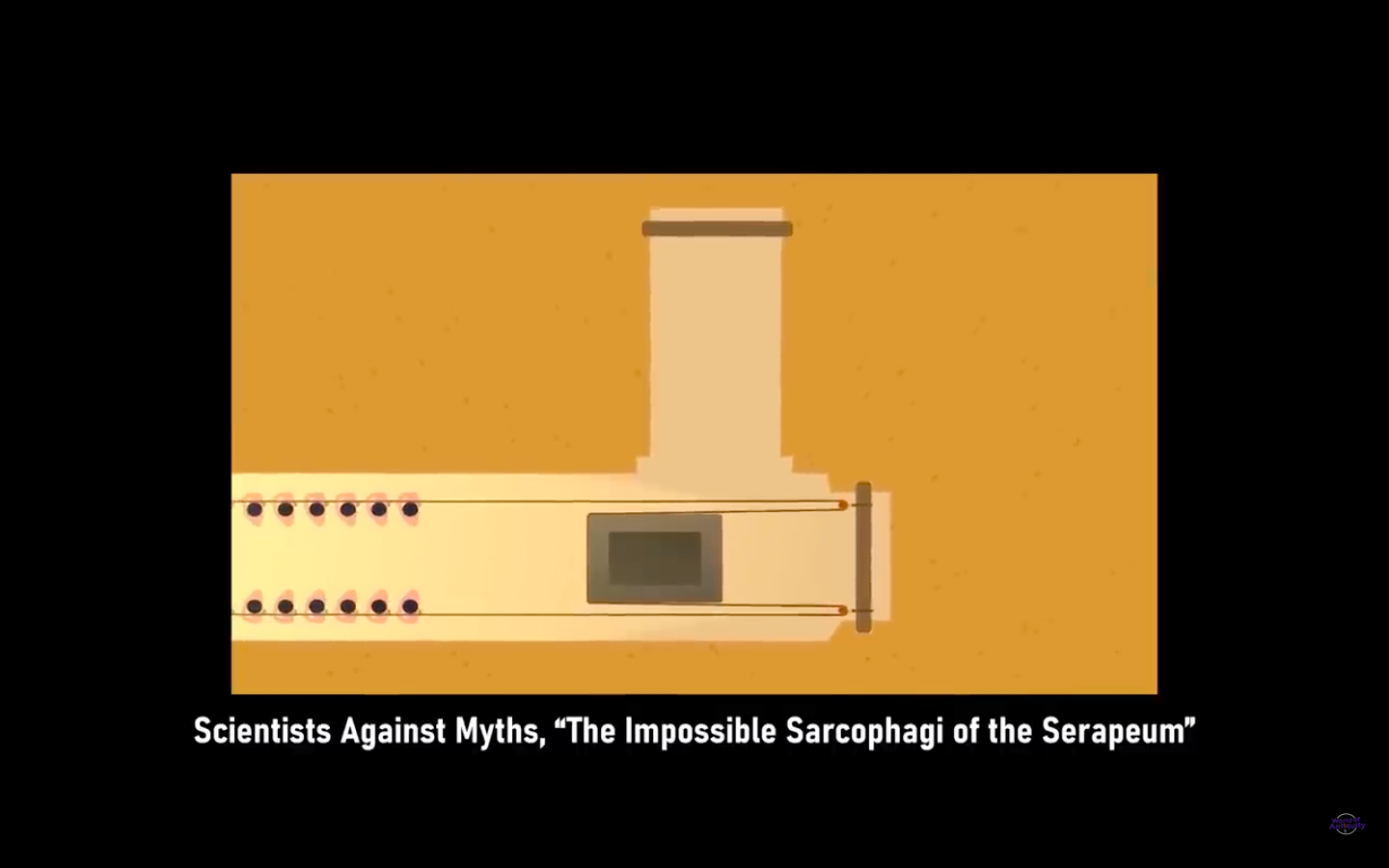
From the Late Period onward, most Apis were buried in large sarcophagi, which weigh around 40 tonnes (88,000 lb) and have 25 t (55,000 lb) lids. They were moved with the help of winches, rollers and levers. To lower them into their final position the chambers were first filled with sand, which was then gradually removed. Only four of the 24 surviving sarcophagi are inscribed. The quality of the inscriptions varies, the ones of Amasis II were beautifully executed, whereas those on an anonymous sarcophagus were only crudely scratched on the polished surface

This is the map of the Serapeum
The next few imagines are from the YouTube channel World of Antiquity. This video is a prime example of how confident mainstream archeology is about how much we know about the ancient past and how ridiculous most of the claims are.




In contrast to the standard narrative, Ben van Kerkwyk of UnchartedX presented an alternative analysis in a Serapeum Series from a few years ago. I hope you will visit his YouTube channel if you want a more in-depth analysis and video of the site. The following photos are pulled from his YouTube videos.


Conclusion
Conclusion and Relevance
Modern construction techniques seek to maximize “profit” above all else. The constraint of ROI and the modern Capitalistic system stands in stark contrast to ancient sites.
A narrative of a separate group of beings with advanced capabilities exist at the base of most if not all of today’s civilizations. It seems strange that all cultures have this concept of “super human” beings
The Context of a Reset
Our view of the present is predicated by our perception of the past. Our views on human nature, hierarchy, and the scarce nature of resources are shaped by the narratives distributed and promoted by our institutions. Broadly, the narrative is that human nature is, at its core, evil, that the elites should rule over the majority and that we have to have a convoluted economic system to distribute the “limited” resources to those who have earned it properly. Either through happenstance or intention we have been conditioned to except these pretenses through educational and religious conventions. We are meant to be cogs in the machine of modernity. When referring to “us” I mean the non-elite, the uninitiated masses. I believe we are living in a sort of artificial paradigm that was constructed for us, not discovered or realized but built, with the intent to separate humanity from the truth of humanity’s past and the realization of its true potential.
It is humanities “lost” past that this series of blog posts and the next few episodes of my podcast will be focused on. My goal is to present the case that humanity was "technologically” more advanced in the ancient past and that we are living amongst the ruins of that humanity. I also hope to present the evidence that we are unable to see the evidence because we were placed in a “simulation” by the elites so we could not realize our true potential, the simulation is so encompassing that many of us, if faced with a choice, would fight to remain incarceration vs wake up to our own liberation.
What is the standard narrative of civilization?
The Start of “Recorded” history occurred in the 4th millennium BCE with the “invention” of writing. The existance of humanity, which archeological evidence has placed starting back 200,000 years ago, is largely unknown. The modern version of history dates back to 6,000 years ago. This means 194,000 years of human existence is almost completely invisible to modern inquiry.
From Wikipedia
Prehistory, also called pre-literary history,[1] is the period of human history between the first known use of stone tools by hominins c. 3.3 million years ago and the beginning of recorded history with the invention of writing systems.
Prehistory refers to the past in an area where no written records exist, or where the writing of a culture is not understood.
Mesopotamia- 10,000 BC
Western civilization- 12th to 9th BC
From the AI Grok
Defining "human civilization" involves identifying complex societies with features like urban settlements, social organization, and often symbolic systems such as writing or monumental architecture. Based on archaeological evidence, below is a list of the 10 oldest known examples of human civilization or proto-civilization, including their locations and approximate dates. These are ordered by the earliest reliable dating, focusing on settlements, monumental structures, or cultural developments indicative of societal complexity.
Göbekli Tepe
Location: Southeastern Turkey
Date: c. 9600–7000 BCE
Description: A monumental site with T-shaped limestone pillars arranged in circles, likely used for ritual purposes. Built by hunter-gatherers, it suggests complex social organization predating agriculture.
Jericho (Tell es-Sultan)
Location: Jordan Valley, Palestine
Date: c. 9600 BCE (initial settlement), fortified by c. 6800 BCE
Description: One of the earliest known settlements with a stone tower and walls, indicating early urbanism and social structure among Natufian and Neolithic peoples.
‘Ain Ghazal
Location: Near Amman, Jordan
Date: c. 7250–5000 BCE
Description: A Neolithic farming community known for plaster statues of human forms, reflecting advanced artistic and social practices. Residents domesticated crops like wheat and barley.
Çatalhöyük
Location: Konya Plain, Turkey
Date: c. 7500–5700 BCE
Description: A proto-city with mudbrick houses, no streets, and rooftop access. It housed up to 10,000 people, with evidence of agriculture, pottery, and egalitarian social structure.
Jiahu
Location: Henan, China
Date: c. 7000–5700 BCE
Description: A settlement with early rice cultivation, bone flutes (oldest playable instruments), and Jiahu symbols, possibly an early form of writing. Abandoned due to flooding.
Mehrgarh
Location: Balochistan, Pakistan
Date: c. 7000–2600 BCE
Description: An early farming settlement with mudbrick houses and crafts like bead production and metalworking. It’s considered a precursor to the Indus Valley Civilization.
Norte Chico (Caral-Supe)
Location: Supe Valley, Peru
Date: c. 3500–1800 BCE
Description: The oldest known civilization in the Americas, with monumental architecture like pyramids and plazas. It lacked ceramics and writing but had complex urban planning.
Mesopotamia (Sumerians, Uruk Period)
Location: Southern Iraq
Date: c. 4000–3100 BCE
Description: The Sumerians developed early cities like Uruk, cuneiform writing, and irrigation systems. Often credited as the first urban civilization.
Ancient Egypt (Predynastic Period)
Location: Nile Valley, Egypt
Date: c. 4000–3100 BCE
Description: Early settlements along the Nile with hieroglyphic precursors and monumental structures. Emerged contemporaneously with Sumer, with advanced agriculture.
Indus Valley Civilization (Early Harappan Phase)
Location: Northwest India and Pakistan
Date: c. 3300–2600 BCE
Description: Known for well-planned cities like Harappa and Mohenjo-Daro, with advanced drainage systems and trade networks. Bhirrana may date back to 7500 BCE, but its status as a "civilization" at that time is debated.
Notes:
Dates are approximate and based on archaeological consensus, but ongoing discoveries may shift timelines (e.g., Bhirrana’s early dates are controversial).
"Civilization" here emphasizes societal complexity, but sites like Göbekli Tepe and Jericho blur the line between hunter-gatherer and settled societies.
Some sources suggest Aboriginal Australian or Khoisan cultures as older, but their lack of urban or monumental evidence excludes them from conventional definitions of civilization.
I avoided speculative claims (e.g., Atlantis) and focused on verified archaeological data. If you’d like a deeper dive into any site or alternative definitions, let me know!
Conclusion from GROK explanation: The earliest evidence, which is all made of stone, is dated to 9600BCE or 11,625 years before present.
What is the alternative history?
“Stuff just keeps getting older” -Graham Hancock
George Howard, a proponent of the Younger Dryas Impact Hypothesis (YDIH) and organizer of the Cosmic Summit, advocates for a catastrophic cosmic impact event around 12,800 years ago (c. 10,800 BCE) that he believes significantly influenced human history and the development of early civilizations. There are two main theories of possible causes for the rapid melting of The Laurentide Ice Sheet, the Comet Impact Theory and a Solar Mass Ejection as proposed by famed Robert Shock.
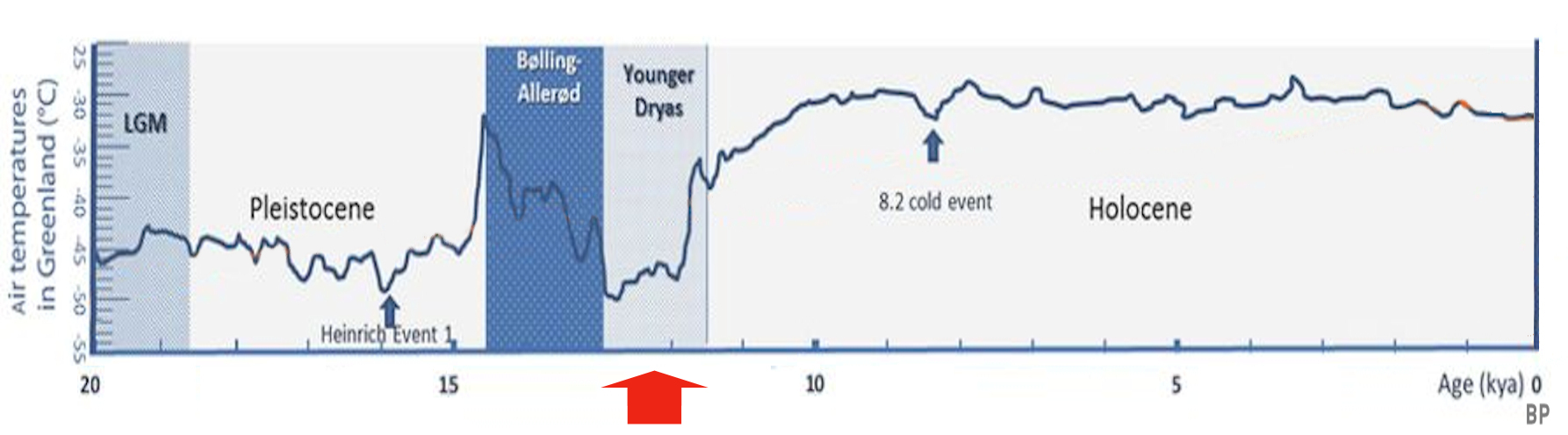
The chart above shows climate warming steadily out of the Pleistocene with a rapid drop during the Bolling-allerad period into peak ice age during The Younger dryas, which is ended by a rapid warming where it has roughly remained till present day. The end of the Younger dryas was marked by a catastrophic sea rise of 400ft.
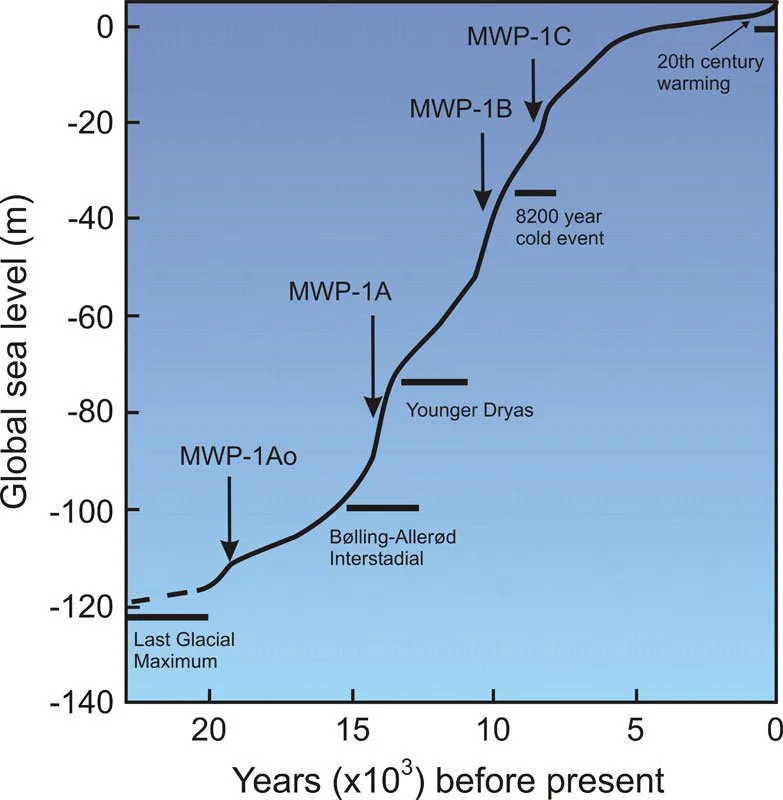
Sea level rise from Last glacial Maximum to today.
Howard’s views align closely with those of Graham Hancock, Randall Carlson, and other alternative history researchers who suggest that many ancient sites may be older than mainstream archaeology proposes, potentially linked to a lost Ice Age civilization disrupted by this cosmic event. Howard’s dating is grounded in the YDIH, which posits that a comet or asteroid impact triggered the Younger Dryas cooling period, mass extinctions, and cultural shifts. His interpretations often combine scientific evidence (e.g., nanodiamonds, microspherules) with speculative connections to ancient myths and geological features like the Carolina Bays.
Randall Carlson presents evidence of catastrophic flows of water that would have completely erased all evidence of a urban civilization of North America.
Dry Falls (in the Grand Coulee area) is significantly wider (3.5 miles or 5.6 km) than Niagara Falls' combined width (about 1.2 km for Horseshoe and American Falls).
Height-wise, Dry Falls is taller (400 feet or 120 meters) compared to Niagara’s 188 feet (57 meters) for Horseshoe Falls.
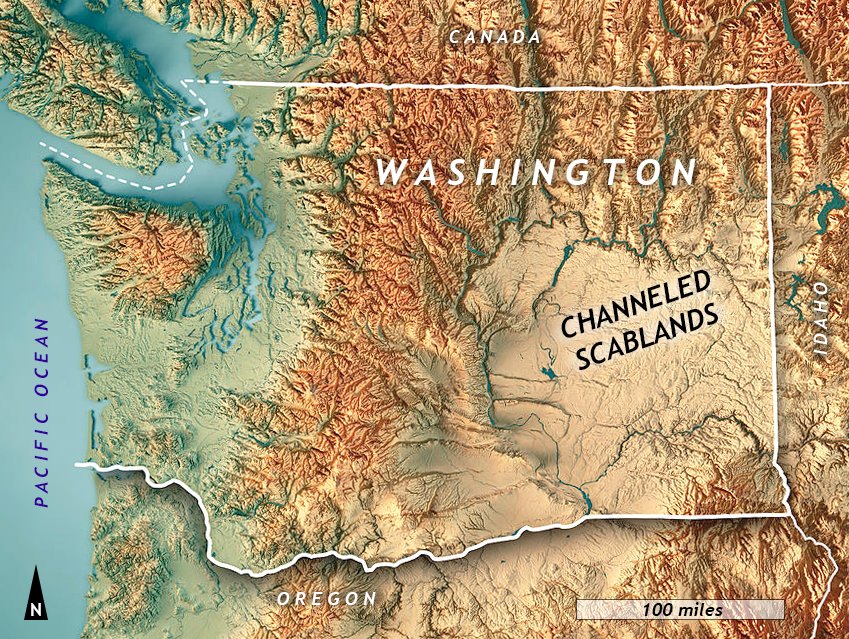
Picture of the Channeled scablands, Evidence for unimaginable water flows.
For more Information to Randall Carlson’s AMAZING YouTube channel for hundreds of hours of in-depth evidence of this truly global and civilizational reset.
Travel by Foot
Everything good in my life I have my wife to blame for. She introduced me to half marathons. Shortly after we were married, she trained for and ran the Hope and Healing Half Marathon in Amarillo, Texas. I remember her going out for training runs as I sat idly at the house, enjoying my comfort. I was always very impressed that she would run for an hour or more. I had run in high school for wrestling, but my max distance was 4-5 miles. I was standing in downtown Amarillo when she crossed the finish line. I felt like a cheater instantly. She had run more miles in one morning than I had run in months. She beamed with happiness. I will always respect my wife for her ability to humble me.
Everything good in my life I have my wife to blame for. She introduced me to half marathons. Shortly after we were married, she trained for and ran the Hope and Healing Half Marathon in Amarillo, Texas. I remember her going out for training runs as I sat idly at the house, enjoying my comfort. I was always very impressed that she would run for an hour or more. I had run in high school for wrestling, but my max distance was 4-5 miles. I was standing in downtown Amarillo when she crossed the finish line. I felt like a cheater instantly. She had run more miles in one morning than I had run in months. She beamed with happiness. I will always respect my wife for her ability to humble me.
I began running because I hated it
I can still remember the pain of not knowing how to breathe. My mouth was instantly dry, and my eyes stung with sweat. I could hear a convincing voice telling me, “Stop, There is no need to run, you are choosing to do this, just stop.” The West Texas sun had superheated the asphalt, and I was sure that the rubber on my shoes was melting between each stride. I could feel the slump enter my back, and the urge to whine crept to the base of my throat. A glance over at my wife disheartened me as she appeared content, happy. She was enjoying what I felt was killing me. I kept my gripes to myself and quietly took note that my fitness had a gaping hole in its game.
Who are you working for
My understanding and perception of physical fitness changed as I ran more. I matured. I looked like I was in good shape and could perform specialized tasks, but I couldn’t perform the basic human task of traveling by foot. Before the advent of automobiles, people rode on horses and buggies. Before that, Humanity spent millennia traveling by foot, carrying supplies on top of all the traveling miles. This is one of the disconnects of modern man. We don’t perform the animalistic tasks which bound us to our physiology. This elimination is to blame for most of our modern ailments. We are a culture strife with sedentary existences. Running is a way to reengage our base nature.
A phoenix will rise from the ashes
I have found running as one modality that never disappoints. It is an activity which will give exactly what is put in. There is no better means of trimming the fat from the mind than pounding pavement.
Call to action: Find a race, set a goal, and then RUN. The point of running doesn’t have to be self-improvement. It is also a perfect tool for self-destruction. Follow me on STRAVA or tag me in a run on INSTAGRAM.
Strong Towns Comes to Amarillo
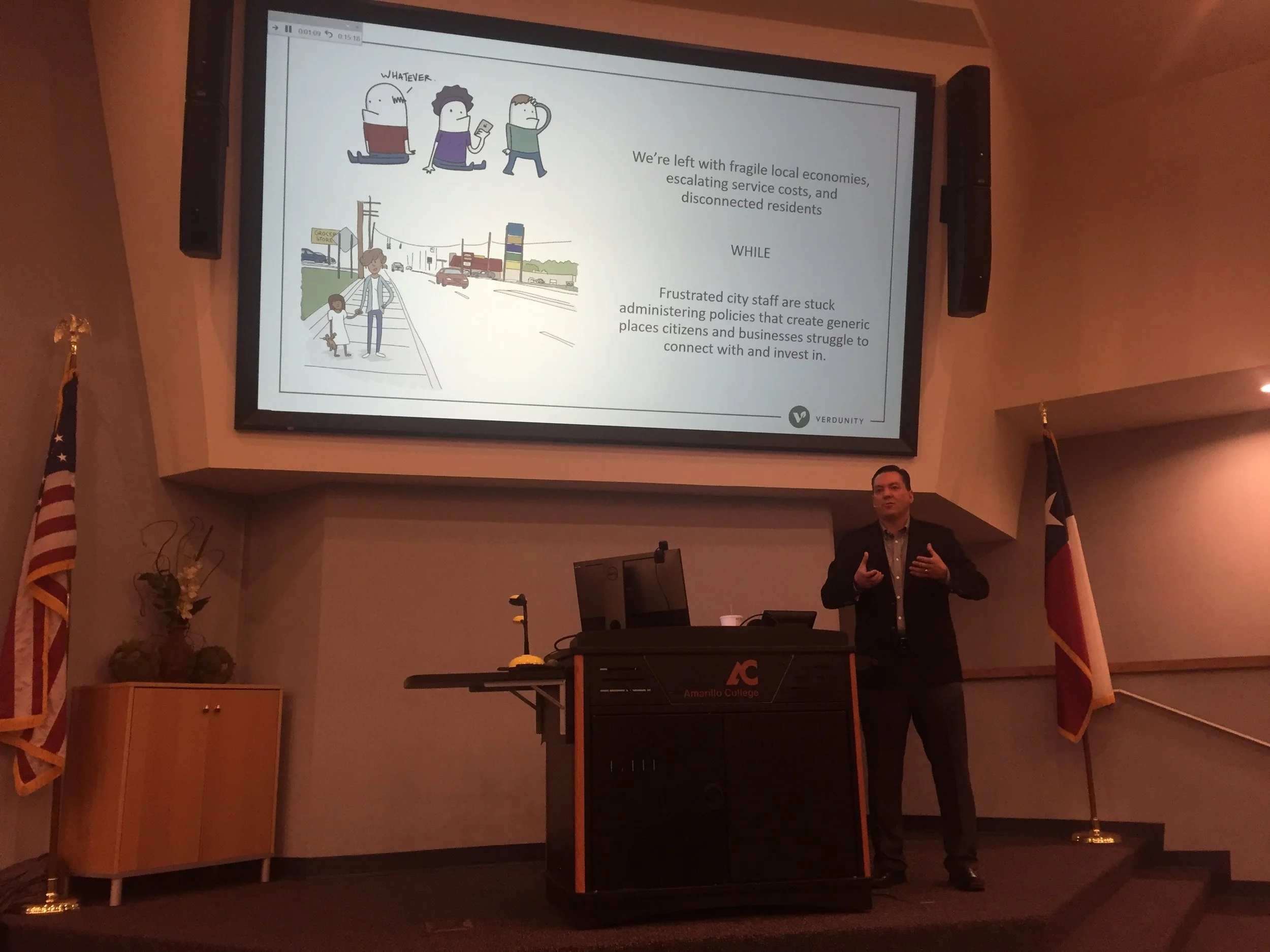
In Amarillo the seasons change abruptly. On the last day of summer, I was sweating in the shade and on the 3rd day of fall a slight shiver traveled up my unbuttoned flannel sleeve as I walked into The Amarillo College Downtown Campus. Kevin Shepherd was giving a lecture called Cultivating Strong Towns and Neighborhoods to a room full of people sharply dressed …and me.

In Amarillo the seasons change abruptly. On the last day of summer, I was sweating in the shade and on the 3rd day of fall a slight shiver traveled up my unbuttoned flannel sleeve as I walked into The Amarillo College Downtown Campus. Kevin Shepherd was giving a lecture called Cultivating Strong Towns and Neighborhoods to a room full of people sharply dressed …and me. I missed the memo announcing business attire but quickly realized the type of people in the room never receive a memo, this is just how they dress. The lecture was open to the public. However, the room was full of businesspeople who showed up for business reasons. Most in the room wrote their name with capitol lettered credentials. City employees and the various money stackers gathered into silence as the young Tim Ingalls called the classroom to order.
Mr. Shepherd P.E began his lecture the way he had begun a thousand, with a question. “How many in this room think your city has enough money for future projects?”. Not a single hand crawled towards the ceiling for fear of showing ignorance. The room was privy to the actions of the wizard behind the curtain. The prosperity narrative of the past decade is a white lie told to the younger generation to ward off despaired. The entirety of human enterprise is built on the lie that we are progressing towards a utopia when in many ways we are running away from it.

Mr. Shepherd, through a riveting presentation of undeniable data and graphs, showed that our current model relies on delusion and an optimistic policy of “kicking the can” of fiscal responsibility to the next year. He explained that our local government, like most across the country, has been borrowing against the house on losing hands for years counting on the next round to pay out. The room had the feel of a doctor’s office just before a terminal diagnosis is delivered. He presented the facts: 22% of the city’s income comes from property tax, 49% of that goes to public safety (i.e. Fire and Police) 11% is allocated to transportation, 1% is spent on streets. Amarillo has 954 miles of paved roads, 83 miles of unpaved roads, and 533 miles of alleys. It costs roughly 1 million dollars to build one 11’ lane-mile of road. If you assume every road in Amarillo is two lanes (22-24’ wide) it would cost a total of 1.908 billion dollars just to replace the existing roads in the city. If Amarillo spread these costs over the next 50 years it would come to 38.2 million a year just to maintain what we have and that’s only streets.
The auto-centric obsession of post WWII American development has covered the landscape with a decadent transportation system which values motorized travel over pedestrians and is cost prohibitive to repair. Our predecessors proclaimed this as investment but delivered debt. An indiscriminate homogenization of our communities has simultaneously occurred as a characteristic of our auto-oriented worship. Developers designed cookie cutter cities which value convenience over character. Our countryside was standardized into an unsustainable model which incentivized a standard of living that destroyed sustainability with unbridled expansion. Our cities feel contrived because the design was focused on the automobile. By ignoring the pedestrian, the grid was developed to require the citizen to own a car. This forces a dependency on cars which disempowers people and perpetuates an addiction to oil, forcing each citizen to become a consumer over a resident.
Big box stores overtook mom and pop shops forcing would-be entrepreneurs out and replacing them with indiscriminate national corporations. These corporations often times receive tax incentives to come to a town and, because of the large footprint of the store and corresponding parking lot, cities fail to generate enough property tax revenue to pay for the streets which surround the store. These “super” stores rely on servicing the large number of consumers who drive in from miles around.
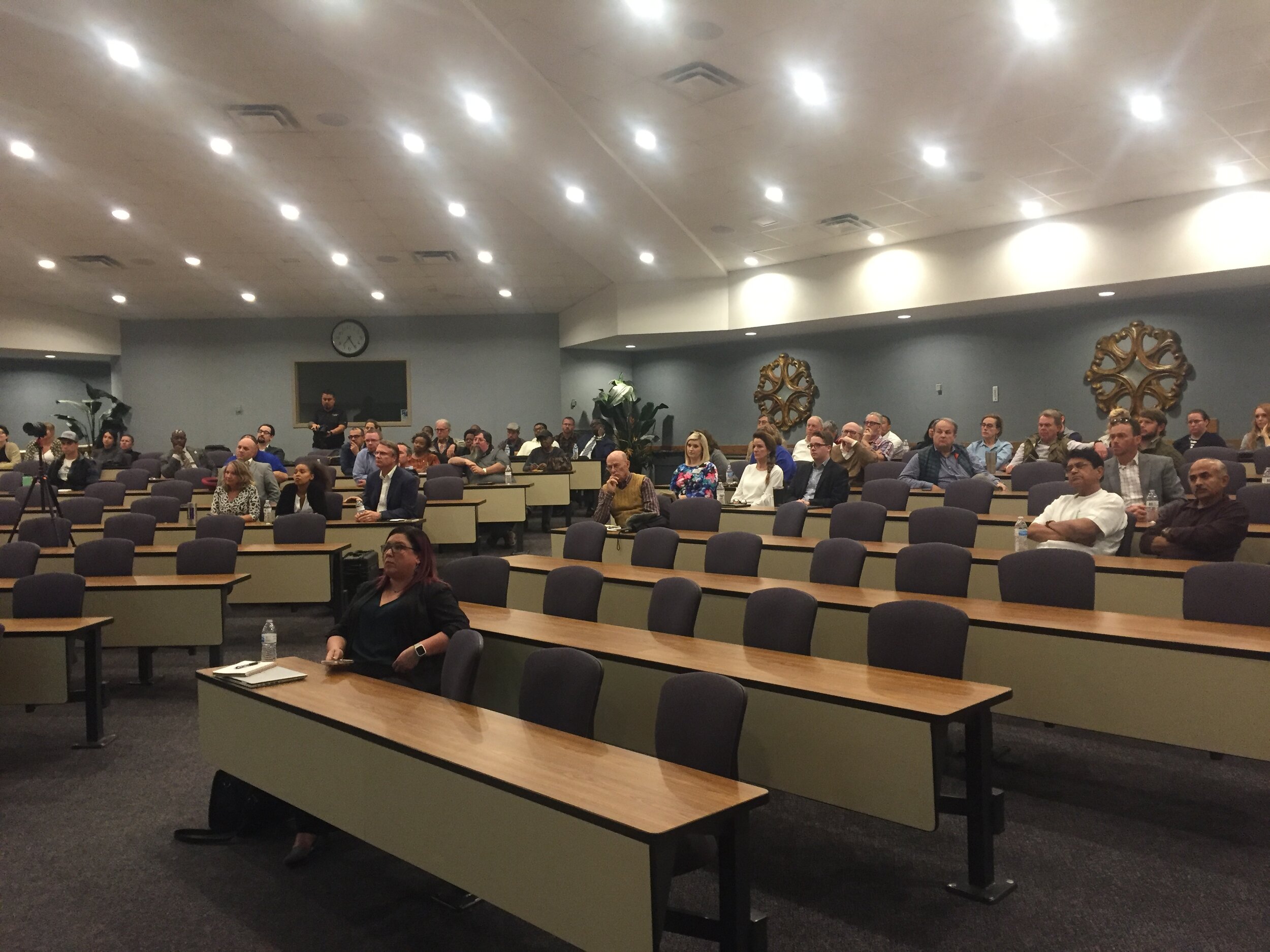
Mr. Shepherd began with a bit of doom and gloom but preceded to present options for correcting the course. Mr. Shepherd encouraged the community to use fiscal sustainability as a common language to guide the city’s development pattern toward one which aligns with what citizens are willing and able to pay for – now and in the future. He said the city has ample opportunities to capture additional revenue and transform downtown into a vibrant mixed-use regional destination by prioritizing people and walkability over vehicles and implementing small/incremental development to develop vacant properties and add small business and residential options in and around downtown.
The plane can still be pulled out of its nosedive. Identifying and acknowledging the reality of the situation is the beginning. Once a philosophy of development is identified as incendiary, steps can be taken to reorient cultural goals and change practices. The city has to be viewed in generational terms through a lens of sustainability. The construction practices and economic justifications of big box stores, fast food restaurants, and sprawling wide roads don’t yield long-term gains for cities. We as a culture have to rethink how we commute and how we consume if we are to create a more sustainable and connected community.
I encourage you to look more into Mr. Shepherd, his firm Verdunity, and the Strong Towns movement, but that was not my only point in writing this blog post. The information that was presented has potential to spark cultural shifting conversations, but there have to be people there to hear and process the info. As insinuated earlier in the post, most of the room were city planning employees or investors. I, at 31, was one of the younger people in the room. The people who were there attended the lecture because they care about the city, but also because they are financially invested in the city and creating a strong city is a way of protecting investments. A large reason that we are facing these problems in infrastructure is because investors have been the only ones represented in these conversations, so naturally, the main concern is private short-term return on investment. Blue collar people who care about a city, not for financial gains, but for quality of life are drastically underrepresented when considering how a city is designed. This means public funds are used to create a platform for private enterprise to prosper, not for private citizens to live. Our towns reflect this sentiment. Developers and investors main motivation is return not long-term functionality.
I never left Amarillo after I graduated from high school, but a lot of my friends did. I can still remember my deep envy as, one by one, my friends moved off to “bigger” and “brighter” things. What was it that Amarillo lacked that these other place’s offered? I can remember conversations with many friends who felt trapped by circumstance and dispiritedly sought a way out. I too felt this way off and on throughout my 20’s. I now see the city differently. Now I have a wife and two young boys and what I am looking for has changed. I have new, older eyes, and I see Amarillo not for what it lacks but for what it is and what it can be. The city is primed, like many aspects of our society, for restructuring. We can identify the concepts that contributed to Amarillo feeling like a cage. With intention and forethought Amarillo can become a town that attracts young people. I hope in 20 years when my boys decide to adventure out into the world they are running towards new opportunities not away from decaying ideals.
This was the first lecture of a series that Tim Ingalls is hosting to get this conversation started. (Link to full lecture here) I would encourage everyone to get involved in this conversation because what we do locally can reverberate out into the national culture. Monte Anderson from the Incremental Development Alliance will be speaking more on these concepts at Mr. Ingalls’ next community education event on November 21st.
Salvation by Cage-Free Media
The Salvation of Cage-Free Media
It was a hot summer afternoon in the panhandle of Texas. The sound of my lawn mower was drowned out by Dan Carlin’s Hardcore History podcast. Physically, I was in my front yard, however, in my mind, I was on the Eurasian steep as one of the most effective conquerors of all history earned his title by ravaging the more “civilized” settled societies of the ancient world. I finished my yard work before the first part of the five-part series Wrath of the Khans was over, and I found myself searching for more work to do. I needed an excuse to continue listening so I could learn how the story had ended. I felt the tug of an addiction forming: I needed a little more, I needed to hear the end.
The Salvation of Cage-Free Media
It was a hot summer afternoon in the panhandle of Texas. The sound of my lawn mower was drowned out by Dan Carlin’s Hardcore History podcast. Physically, I was in my front yard, however, in my mind, I was on the Eurasian steep as one of the most effective conquerors of all history earned his title by ravaging the more “civilized” settled societies of the ancient world. I finished my yard work before the first part of the five-part series Wrath of the Khans was over, and I found myself searching for more work to do. I needed an excuse to continue listening so I could learn how the story had ended. I felt the tug of an addiction forming: I needed a little more, I needed to hear the end.
Hardcore History was one of the podcasts that first opened my eyes to the potential and versatility of new platform-based media. There was no longer a “gate keeper” as Carlin refers to them, controlling the flow or dissemination of information to the masses. New Media platforms such as podcasting, blogs, and social media offer a way of sidestepping the bottle neck of a media conglomerate/corporate companies. This frees creators to create without the pressure of impressing or catering to a specific target audience. The Joe Rogan Experience, another paradigm shattering show, and Hardcore History are essentially on the same “network,” but are very different shows in style and purpose. Technology now allows private individuals an unprecedented ability to project their thoughts and opinions to other individuals. When enough like-minded individuals gather, they form into crowds…and with crowds come revolutions.
A quick zoom out for historical context. Throughout the ages, there have been many “new” forms of media. Humanity took its first baby steps towards media by developing spoken language anywhere between 2 million and 50,000 years ago. As you can imagine, this is a difficult thing for archeologist to pin point because no “evidence” has ever been collected. That came with the next advancement of written language, with the first evidence appearing on clay tablets in 3100 BC in Mesopotamia. With this advent, a new class of people became necessary: the scholar/priest. These people had to spend long hours learning how to read/write in order to keep records, provide historical context for their present society, and tell their story to the next generation. In these early days of written communication, reproducing literature/knowledge was a painstaking task: each line had to be hand copied. This was until the printing press was invented by Gutenberg in 1440 AD. With this new technological platform, information could be disseminated to the masses in the language of the common man by the common man. This lead to a wide range of revolutions both religious, in the Protestant reformation, and in thought, with the Enlightenment and the corresponding scientific revolution. Fast forward a few hundred years to 1990. The Internet’s potential, after rumbling for the better part of the 20th century, was realized when Tim Berners-Lee invented the World Wide Web. The WWW is a platform which operates through the internet, creating a user-friendly interface for sharing information. This coalescence of concept and technology was the realization of what Gutenberg had started all those years before. Now each person with the means and intention can “broadcast” their thoughts, opinions, and perspective all over the world.
Zoom back in on the young man sweating in his front yard. The realization that I was in the middle of a historical revolution was beginning to occur to me. With internet-based media, everyone is equal and location doesn’t matter. There is no interview process before stepping behind a microphone, in front of a camera, or sitting down to a keyboard. For better or for worse, everyone’s thoughts and opinions can be projected to the masses. This is a revolution of opportunity. People who were normally forgotten by history can now stand up and be counted. Educators have used the flexibility and reach of the internet to built entire schools online and offer endless educational resources. The average man now has a louder voice and more resources than any other time in history. Because of the internet, an entirely new type of society is being built where who you are is far less important than what it is you choose to be about. The most dangerous thing for the stability of a culture is allowing the citizenship the opportunity to build a culture for themselves.
Hardcore History remains one of my favorite shows because it provides a historical context for the present time. The people of ancient China, for instance, feared that Genghis Khan was destroying the world during his conquest, and for many Chinese, their world did end, but history continued to march forward, and their suffering became a remnant of the past. The digital revolution, just as with the printing press, will reform some institutions, destroy others, and create entirely new ways of thinking. There is always a period of instability between the old world being destroyed and a new world being built. We have some very real problems to deal with in the wake of collapsing institutions, and a new society will present new challenges. These problems, along with their solutions, will be how our era is defined.

But I Hate Running
It was 6am on a Saturday and it felt as if the whole world was asleep except me. I set the coffee to brew and I peeled a banana. The early morning dark still lingered outside my kitchen window. The nerves of anticipation grew in my mind making me feel like a child again. My old house creaked as I paced back and forth running a system check of my legs and feet. Everything felt good and I was excited. With a gurgle and beep, the coffee was ready. I grabbed a Clif bar and went to the living room to check my gear before my buddy, Chris, picked me up. Socks and shoes were on my feet and tied, shorts were on, shirt with numbered bib, my phone, phone holder and headphones. I felt like I was missing something. In a world of endless options, running feels too simple. Now in my late 20’s, it’s the minimalistic nature of running that drew me to the sport. All you need is a pair of shoes, some earth, and a reason to run. Finding a reason to run is the hardest part.
It was 6am on a Saturday and it felt as if the whole world was asleep except me. I set the coffee to brew and I peeled a banana. The early morning dark still lingered outside my kitchen window. The nerves of anticipation grew in my mind making me feel like a child again. My old house creaked as I paced back and forth running a system check of my legs and feet. Everything felt good and I was excited. With a gurgle and beep, the coffee was ready. I grabbed a Clif bar and went to the living room to check my gear before my buddy, Chris, picked me up. Socks and shoes were on my feet and tied, shorts were on, shirt with numbered bib, my phone, phone holder and headphones. I felt like I was missing something. In a world of endless options, running feels too simple. Now in my late 20’s, it’s the minimalistic nature of running that drew me to the sport. All you need is a pair of shoes, some earth, and a reason to run. Finding a reason to run is the hardest part.
Chris pulled up right on time and we were off. We were both excited and feeling good about the race. The empty roads and predawn glow gave the morning a forbidden feel. The city seemed liberated; in the pale light, it felt more genuine. A crowd of weekend warriors were amassing as we pulled up. These weren’t the same people who worked in law offices or sold insurance during the week. These were warriors focusing their minds and loosening their limbs. Lighthearted laughter floated through the air as we walked towards the starting area. The vibe of the crowd was excitement, and the feel of anticipation was all around. There was a slight breeze, and the chill from the night before was still in the air. Chris and I found a spot in the crowd and said our last good lucks before the race started.
There aren’t many feelings like running in a large group of people. The clap of feet on the ground and the collective sounds of breath are a form of worship. Each person had to make sacrifices to be part of this congregation. The solidarity of participation is a powerful drug. Each person had their own reason for being out there: maybe a new year’s resolution, a personal fitness goal, a commitment to a friend. Whatever the reason, the setting is the same. A group of civilized humans scratching a primal itch.
That was my first half marathon. I never thought long-distance running was a sport I would enjoy. My mentality about running had always been a means to an end; I ran to develop cardio for sports like football or wrestling. I told myself that I hated running because I felt like I wasn’t good at it. With age grows maturity, and I now realize that doing something simply because you are good at it is how cowards live their lives. Intellectual and physical growth come from examining the aspects of your life that you aren’t “good at.” The faults are where you should start. I now identify as a runner not because I am good at running, but because I frequently run. The only price of admission to the show is the willingness to participate.
Don’t take my zealous view of running as delusion. I am still a young man, and I acknowledge that enjoyment is somewhat determined by the vantage point of age and the consequent health of one’s joints. Someday in the future I may come to hate running again. I may see the insanity of running the same streets expecting to experience something new. For now, I choose to train, and I will continue to sign-up for races. I might never be the fastest. I will, most likely, never break any records. But I have come to enjoy getting participation trophies. What I once viewed as a consolation prize I know see as badge of commitment. So, I will continue to participate and I will redefine what it means to win.

At the finish line with Emmett
Running resources:
· Strava- A running app that allows you to connect with friends and co-workers. This app offers data about your run and is a great way to track progress and gain motivation.
· Born to Run by Christopher Mcdougall- In the book, Mcdougall explores the world of ultra-distance racing and investigates the long distance running history of our ancestors. The human physiology is adapted for long distance running and many experts believe that the first humans practiced persistence hunting, a technique where a group of humans chase an animal until the animal is too tire to run any further. Mcdougall highlights a tribe of humble people from the wilds of Mexico, a tribe known as the Raramuri. This tribe holds ultra-distance running at the center of their culture. This book is well worth the read, and if it doesn’t inspire you to stretch your legs, there is likely nothing that will.
· When in doubt, find a friend. Running is a singular pursuit, but the experience is easily shared by a group. Go into your local running shop (Get Fit in Amarillo, Tx) and ask about group runs and ways of getting involved. Runners are very inclusive and generally eager help you onto your journey.
· Something to bump in your Headphones- I listen to podcasts and Spotify to pass the time on runs. Some of my favorite podcast are:
o The Liturgist
o Duncan Trussle Family Hour
o Tangentially Speaking with Christopher Ryan
o Hardcore History with Dan Carlin
o Radio Lab
o Joe Rogan Experience
o Think Again: A Big Think Podcast
o Freakanomics Radio
o Waking Up with Sam Harris
o Aubrey Marcus Podcast
o Mixed Mental Arts
On Spotify I like to listen to rappers such as:
o Kendrick Lamar
o Lupe Fiasco
o Mick Jenkins
o Isaiah Rashad
o Talib Kweli
o Outkast
o Ab-soul

The Lost Wilderness of a Man's Soul
I always had trouble sitting still in class. With the most earnest intent I would scoot forward, hands placed on my desk, eyes trained on the teacher in front of me. The focus would never last. My mind was a wild animal and I was a poor wrangler. Stories bounced around inside my mind, I was powerless in bringing them under control. The straight lines of the classroom begged to be stressed until broken. The most meaningful conversations always happened outside, in the hall, as a grown up pushed to tears of frustration screamed at a child who truly meant to pay attention. I wanted to be a good kid, but attention was a gift I could not give. I was as frustrated with myself as anyone. The system was easy enough though and I was always able to get passing grades. I ended up being a fair enough student but I always wondered if there were another type of classroom, one I would have fit into better.
I always had trouble sitting still in class. With the most earnest intent I would scoot forward, hands placed on my desk, eyes trained on the teacher in front of me. The focus would never last. My mind was a wild animal and I was a poor wrangler. Stories bounced around inside my mind, I was powerless in bringing them under control. The straight lines of the classroom begged to be stressed until broken. The most meaningful conversations always happened outside, in the hall, as a grown up pushed to tears of frustration screamed at a child who truly meant to pay attention. I wanted to be a good kid, but attention was a gift I could not give. I was as frustrated with myself as anyone. The system was easy enough though and I was always able to get passing grades. I ended up being a fair enough student but I always wondered if there were another type of classroom, one I would have fit into better.
I felt like a peasant shuffled through a system designed for the masses. One among many. I was the proverbial square peg in a world of circular holes. Early on I was told I had a “learning disability” which was cited as the cause of my obtuseness. I couldn’t read very well and my spelling was atrocious. I don’t blame the system, I would have rejected me as well. My "disability" seemed to not only be dyslexia but also a lack of desire to make the grade, the incentives for success were lost on me. Educators promised fulfillment and prosperity, two things I sensed to be a facade. A mirage in the desert, promising to quench my thirst if I just made it a little farther. Its attempt to replace the inner light of a child with the faint glow of adult life.
The doctrine the school system preached seemed to contradict the world I experienced inside myself. Inside I was a wilderness filled with savage animals of love and hate, joy and sorrow, elation and despair. There were no straight lines and I didn’t have to raise my hand to speak. Inside were plenty of questions that required no answers. Each day I was told to come to the real world, to quite the voice within and listen to what the state was telling me. But the voice inside kept growing louder. It cried “Bullshit” and proclaimed the school-taught reality as blasphemy. Man was not built for public school; no system can encompass the intricacies of man. Joy and fulfillment will never come from quantifying your existence by the scale in someone else’s hand. A passing grade means nothing outside of the classroom. Curriculum is what others have deemed necessary; striving for a piece of paper seemed empty of any true meaning.
Public education is a blessing. I certainly owe a portion of the fire which burns in my mind to the dedicated educators that struggled alongside me, but as is true with any progress, there must be a sacrifice. The free spirit of an unruly child, in my case, sacrificed to the gods of systematic order. I was taught my identity one scold or praise at a time. However, the most valuable lessons of my short life weren’t in a state sponsored class room or by a state appointed educator. Education is not something that should be shoved down the throat of the masses as quickly and efficiently as possible, it should be a lifelong pursuit which follows the flow of one’s life. Education is often a slow process from which you never graduate. Truth is in the very air we breathe and resounds with every thump of the heart. Any person who helps you to open your eyes more fully to the world that surrounds you is an educator. We must change our view on education from something that is attended to something that is lived if we ever hope to liberate humanitie's true potential.
Death to the helicopter parent
The tiny fat hands of my 8-month-old son grasp my fingers as he balances precariously on fat little legs, the concept of taking steps still not present in his young mind. I lean him forward in hopes that the shift of center will encourage the natural step towards equilibrium, but no step follows. A gummy smile beams upward at me as if to tell me he is content with simply standing. He won’t remember these hours of disbelieving stares and light hearted laughter like I will. The amazement of a young parent enshrined in blissful memories. My heart is heavy in my chest as I realize I am watching a baby progress into a kid. Soon he will have thoughts of his own and a will to speak the words of his own crafting. As I was contemplating these thoughts, my son decided to attempt a dive, catching me completely off guard and reminding me that, even now, I do not control him. He is a sovereign citizen of life and in life there are consequences.
The tiny fat hands of my 8-month-old son grasp my fingers as he balances precariously on fat little legs, the concept of taking steps still not present in his young mind. I lean him forward in hopes that the shift of center will encourage the natural step towards equilibrium, but no step follows. A gummy smile beams upward at me as if to tell me he is content with simply standing. He won’t remember these hours of disbelieving stares and light hearted laughter like I will. The amazement of a young parent enshrined in blissful memories. My heart is heavy in my chest as I realize I am watching a baby progress into a kid. Soon he will have thoughts of his own and a will to speak the words of his own crafting. As I was contemplating these thoughts, my son decided to attempt a dive, catching me completely off guard and reminding me that, even now, I do not control him. He is a sovereign citizen of life and in life there are consequences.
Snatching the confused child just before he hit the floor, I was just as shocked as he was. The surprise of instant reaction dumped an ever so slight amount of adrenaline into my system, causing a euphonic excitement. Sure, my kid almost crashed into the hard wood floor, but I caught him. The scene reminding me to never underestimate the explosive power of will harbored in the human potential of intent.
In 2009, I was 20 years old, children and wife far from my mind, when my friend Zack, who had been attending outdoor school in Alaska, invited me on a 10-day sport climbing trip in Mexico at an area known as Potrero Chico. This would be my first ever sport climbing trip. I had done a fair amount of bouldering, a ropeless form of climbing that relies on thick pads of foam to cushion the landing in case of a fall, however, sport climbing is roped climbing and relies on quick draws and pre-place bolts for safety. I had seen it done and was sure there was nothing to it. Knowing that I had never been on a rope outside didn’t even cross my mind as a deterrent. I booked the trip with the bravery that comes from youthful ignorance. My parents professed a slight resignation towards my safety, but still gave a nod of encouragement.
It was early afternoon on the first day of my trip just outside of the town of Hidalgo, Mexico, and I was at the top of the Virgin Canyon, one named for the shrine of the Virgin Mary that lay at the entrance to the lime stone canyon. I was roping in at the base of a climb named Mr. Jesus, a 5.10 that Zack assured me was a good first lead. My heart raced and I could feel butterflies not only in my stomach but tickling the upper parts of my throat. I had been working a minimum wage full-time job for the past year and had climbed very little in preparation for what I was about to attempt. My hands were sweaty as I tied the end of the rope into my harness, all the while Zack verbally explaining how to do what I was about to do, his hands swinging in repetitive motions above his head demonstrating how to clip the bolts and lace the rope into the drawls. I dazed off in thought, wondering if a route named Mr. Jesus would be considered sacrilegious, this gap in consciousness caused me to only catch every emphasized word of instruction. Stance, bla bla, clip, don’t do, make sure you, yada yada.
Next thing I knew, I was at the crux of the climb. My toes cramped and forearms screamed, attesting to the unprepared nature of my fitness. After two or three desperate moves, I mantled onto a 3-inch-wide ledge, shocked that I had pulled the section, sheer luck and terrified ambition to blame. A bolt was directly in front of my face and a few easy looking moves lay between me and an on-site send of my first outdoor lead route. Elation comes to mind to describe my emotion. This glory was momentarily lived as Zack’s next advice startled me. “Take a fall!” Zack hollered up to my height. “This would be a safe first one to take.” My apprehension was a testament to the necessity of his advice. You can’t perform full octane if you are a scared little bitch. So, I made the impulsive step backward of blind faith and, before I knew what had happened, the terror of free fall had subsided as I settled onto the tension of the rope, cradled in my harness. I let out a relieved scream as the excitement filled my very toes. Zack let out an approving “right on man, now climb it again and clip into the chains at the top!”
This next part is where the magic of consequence that creates character and resolve appeared. The blur of fury that had accompanied my first go at the crux was replaced with the crystal-clear reality of fatigue and rationality that this may be a little much for me. Grasping a slightly different sequence of holds left me in a more difficult position than my previous attempt, resulting in me being forced to grab a vertical slot resembling the letter V. The gap at the top permitted my middle finger to slide in stacking my index and ring on top. In the next moment, my foot, which was precariously placed on a slick edge, popped causing me to fall and settle out three feet below my last bolt. Disappointment rushed over me. I had fallen on the section that I had climbed, scared and desperate, not 4 minutes earlier. The disappointment was quickly replaced by horror as I glanced down to a stream of blood pouring from my now filleted finger. The flow of blood was so heavy that it precluded my vision of seeing the true extent of the damage. “Lower me!” I yelled receiving the expected response of “Finish it! Get to the top!” “I can’t! lower me.” This time, Zack’s response was the release of tension and the consequential dissention of my physical body resembling that of my metaphysical psych.
Reaching the bottom, my climbing partner observed the carnage. Blood flooded as swift as the waters of the Guadalupe river that separated me from my home state of Texas. “That’s not good,” Zack stating the obvious and true statement that flowed through both our minds. A climbing trip consists of toes and finger tips and I had just shredded my left middle finger the first hour of the first day of climbing. I removed my shirt, tightly wrapping it around my finger and held it over my head. I was properly fucked.
As we descended the canyon, I resisted the temptation to look at my finger knowing that it would reveal bad or worse news. Zack was gleefully telling me about a multi-pitch climb that he had climbed the day prior, attempting to occupy my focus. It worked and by the bottom of the canyon, my youthful resilience and since of humor had replaced my dread. I almost looked forward to the inspection of my injury, accepting the lack of real pain as a good sign. Peeling away the shirt from the congealing blood revealed an inch-long slash on the left side of my left middle finger. I was not much of a drinker back in Texas, as I was only 20 years old, but this was Mexico and the law of the land permitted me a mixed buzz of tequila and cheap beer. Since the cut was on the side of my finger, I had, in drunken stupor, convinced myself that I was better than fine. Assuredly this would be the last injury of the trip and I was lucky to escape with so minimal damage I told myself. That night ended with me half in half out of the tent throwing up and passing out. The next morning my head hurt far more than my finger as I headed up the various canyons in search of the natural high which accompanies the clipping of bolts.
I am already nervous imagining the precarious situations that my young son will one day find himself in. I know that I will have to let him bleed, to experience consequence, if he hopes to ever find himself. I am temped to tell him to only be safe, to insist that he adopts my worries and fears as his own. With loving intent, we have created a helicopter society with the goal of protection from the dangers of our own nature. Yet it is the excitement that comes from the unknown and undefined characteristics of nature that allows access to creative design and the innovative spirt innate in the human soul. The flame of human potential burns brightest in the ambition of unrestrained youthful actions of those who dare to find their limits. Limits are only found where consequence is present. Helicopter parenting is a natural inclination. In attempting to protect children from adversity, we offer protection from the very thing that gives life its meaning. The blessings of the human condition manifest as both pleasure and pain and you can’t experience one without the other. Through suffering, salvation is found. In the sacrifice of the helicopter society there will be blood, for it is the blood you leave behind that you will remember, not the blood that stays safely with you.


Shitty car guru
For a young man, I have an extensive history with old vehicles…not the refurbished diamonds of a golden era type, but the old vehicles that even new were considered bargain types. As a child, I distinctly remember the winter ride to school, snow whirling in my lap, cold air on my face due to the absence of a window. There were old trucks, the occasional turn of the key without the accompanying turn of the engine. A light-hearted demeanor is required when faced with a ride that won’t roll. Humility cultivated by stepping out of a sputtering steed to a school lawn filled with classmates. It was a blessing, from that early age, to not be reliant on the quality of a possession for worth or security. It all works out. Momentary inconvenience, given time and distance, grew in my mind to provide a clearer perception that I was not what my parents drove.
For a young man, I have an extensive history with old vehicles…not the refurbished diamonds of a golden era type, but the old vehicles that even new were considered bargain types. As a child, I distinctly remember the winter ride to school, snow whirling in my lap, cold air on my face due to the absence of a window. There were old trucks, the occasional turn of the key without the accompanying turn of the engine. A light-hearted demeanor is required when faced with a ride that won’t roll. Humility cultivated by stepping out of a sputtering steed to a school lawn filled with classmates. It was a blessing, from that early age, to not be reliant on the quality of a possession for worth or security. It all works out. Momentary inconvenience, given time and distance, grew in my mind to provide a clearer perception that I was not what my parents drove.
Today, if I have a solo requirement of work or errand, I drive a ’99 Honda accord. The distinct clicking that accompanies right hand turns testifies to its road worthiness. $1,000 worth of metal and rubber propelling me towards my intentions day after day. The radio speaks to a time before the iPhone and roaming internet access. Upon arrival at each destination, I am greeted with the feeling of relief that can only come from the roll of a dice, thanking the gods of the road for granting me one more trip without a breakdown. The purr of inanimate life from beneath the hood is temporary and precious, a reminder that nothing in this world last forever.
I will eventually buy a newer car, replacing one tool with another, but I hope to never escape the lesson that my shitty car has taught me. No matter what I drive, I gain no value and lose no worth. The illusion that you are what you drive erased and replaced with the truth that you can be something more. You can choose your own perception of your circumstance, choose to see the blessings or the curse. You are free to craft the light in which you see your own life. As a painter paints a picture you to are free to frame yourself however you like. I choose to drive a shitty car…for now.
Is climbing a mountain worth the cold?
Do you desire adventure? This is a question that I often find myself wondering. The movies are great and the vacations are fun but those are often romanticized versions of reality: a snapshot of the long journey. The camera is conveniently off when the main character of the featured presentation twists his ankle, the viewer doesn't feel the sting of pain. When Romeo steps in shit, Juliet doesn't complain of the stench or even tell him to remove his shoes. A life of grand adventure requires payments along the way. From financial instability to physical anguish, the true extent of the cost is never known until it has already been paid. Living a life of adventure seems like trying to escape from chains of comfort, like a prison filled with recliners and 1000s of devices designed to keep you comfortable, safe. Why would one sacrifice the comfort of looking at a pretty picture for the struggles of being there yourself? After all, you don't have to smell the shit when you experience it through a picture.
Do you desire adventure? This is a question that I often find myself wondering. The movies are great and the vacations are fun but those are often romanticized versions of reality: a snapshot of the long journey. The camera is conveniently off when the main character of the featured presentation twists his ankle, the viewer doesn't feel the sting of pain. When Romeo steps in shit, Juliet doesn't complain of the stench or even tell him to remove his shoes. A life of grand adventure requires payments along the way. From financial instability to physical anguish, the true extent of the cost is never known until it has already been paid. Living a life of adventure seems like trying to escape from chains of comfort, like a prison filled with recliners and 1000s of devices designed to keep you comfortable, safe. Why would one sacrifice the comfort of looking at a pretty picture for the struggles of being there yourself? After all, you don't have to smell the shit when you experience it through a picture.
Adventure lies beyond obstacles like comfort and conformity. Breaking the rules and living in the extremes demands an aggressive lifestyle. Victory lies on the far side of struggle. Strength and fortitude develop with each step forward. The exhilaration of completing a life goal is only felt when one has sacrificed for it and is brave enough to cast away the tendencies that prop up a mediocrity life. One has no time for self destructive habits when the task requires your best self to show up in order to succeed. Laziness is not a option. Complacency is left far behind when one realizes that time is a resource that is bound to run out. Bravery and courage feed upon the conquest of each limitation. Confronting failure is common, for failure is often a welcomed companion on the way to victory. Like the stone sharpens the knife by knocking off the fringed shards, failure shapes the champions resolve. As resilient as the sun rise. The adventure marches on.
At last the context for my conundrum. On the road to the greatness it would seem there are few recliners.
Shannon before a particularly difficult day at Mt. Evans

Generational Beef
Generations come and go. Often it isn't until one is gone that the true scope of it's culture can be interpreted and defined. It is easy to see the negatives with the younger generations. Youth always expresses itself more with passion than wisdom. Older generations are strapped down by a life lived and struggle to reconcile their decisions against the sometimes irrational nature of the younger. Definition is often dependent on the extremes of each generation. The generation that sent man to the moon. The generation that fought world wars. The generation that discovered the world. As things get done, one might sit back and say that the best is behind and the future is bleak.
Generations come and go. Often it isn't until one is gone that the true scope of it's culture can be interpreted and defined. It is easy to see the negatives with the younger generations. Youth always expresses itself more with passion than wisdom. Older generations are strapped down by a life lived and struggle to reconcile their decisions against the sometimes irrational nature of the younger. Definition is often dependent on the extremes of each generation. The generation that sent man to the moon. The generation that fought world wars. The generation that discovered the world. As things get done, one might sit back and say that the best is behind and the future is bleak.
Often the rules we are taught are to avoid the short comings of generations past. To accept the wisdom that has proved to be true. These are based on assumptions about life that are not promised. If you could plan your whole life out, subtracting all the "bad", would you? Get married, have perfect kids, endless money, travel the world. If the world was your's how would you live?
I have always struggled with the status quo. Why do we all need to play by the same rules? Why should I care about money? Why define people by something they bought? Tyler said it best "Your not your f@cking khakis". Each day is a new day and will never exist again. Step up and be nice to someone for no reason, take care of your self, sculpt your life so that you walk around content with the fact that it could all be over without you getting a vote. You define your life, not some distant douche bag that will assign your generation a intellectual title. X Y Z? You don't know me Bro!

random reflection of a mountain morning
In the mountains it is easy to wake up with vigor. You will surely need it throughout the day; vacationing in the mountains is often tiresome work. The mountains provide an atmosphere of ambition that leads to exhaustion. I know how hard my day will be and it causes me to smirk. I enjoy my morning cup of coffee knowing the harder the day, the more fun. Knowing first thing in the morning that, lord willing, your hardest day, where YOU, not anyone else but YOU, will either rise to the challenge and go home a winner, or you will crumble and be forced to attempt the task another day.
In the mountains it is easy to wake up with vigor. You will surely need it throughout the day; vacationing in the mountains is often tiresome work. The mountains provide an atmosphere of ambition that leads to exhaustion. I know how hard my day will be and it causes me to smirk. I enjoy my morning cup of coffee knowing the harder the day, the more fun. Knowing first thing in the morning that, lord willing, your hardest day, where YOU, not anyone else but YOU, will either rise to the challenge and go home a winner, or you will crumble and be forced to attempt the task another day.
People tell me this vigor should be reserved for vacations: that exhilaration is revered for the ultra-rich or the ultra-athlete. I often wonder why people don't consider themselves the extraordinary? Why should living the life that you want be the exception? Fear is a invisible force that contradicts vigor. It tells you to keep out of the drivers seat, to never leave the trail, and to stop thinking you can do more. Be happy with a life that you didn't choose.
The truth is, that no matter your surroundings, vigor and fear lurk about. Like two campfires cutting the darkness of the night, you choose which fire you add the wood to. The fire that produces the majority of the light controls your perspective. Recognize the mountains around you, plot over your morning coffee how you are going to rise with vigor and conquer that bitch.


That's smoke Darling: ColoRado pt.1
A road trip can not happen with out a healthy steed. A few hours in and with a few more to go my steed was dumping white smoke down the highway and into the cab. I feared it was the beginning of the end of my 2003 sprinter van. I eased to the shoulder. Stopped, I set out to investigate. A 13 day trip around the Colorado front range lay a few hundred miles up the road but I was laying on a asphalt road with a smoking van. I didn't see any obvious damage or leaking. Hopping into the driver's seat I answered my wife's concerned look with a reassuring nod, a turn of the key, and a "We should be good". The old tin can held together the rest of the trip with no more issues. Minor problems like this are common at the beginning of a trip, the God of the Road checking your dedication.
A road trip can not happen with out a healthy steed. A few hours in and with a few more to go my steed was dumping white smoke down the highway and into the cab. I feared it was the beginning of the end of my 2003 sprinter van. I eased to the shoulder. Stopped, I set out to investigate. A 13 day trip around the Colorado front range lay a few hundred miles up the road but I was laying on a asphalt road with a smoking van. I didn't see any obvious damage or leaking. Hopping into the driver's seat I answered my wife's concerned look with a reassuring nod, a turn of the key, and a "We should be good". The old tin can held together the rest of the trip with no more issues. Minor problems like this are common at the beginning of a trip, the God of the Road checking your dedication.
Several hundred miles later... We pull into the lot of a cool little brewery in Golden, Co. We enjoyed a few brews with our buddy Blake and his buddy Robb. Company was prime and the beers were cold. We decided to go to Mt. Evans the next day and cruised over to Robb's to park and get some shut eye.
7 am came and went. Shannon and I were feeling sluggish. I sent a wake up text to Blake. My hopes for more sleep were crushed with a quick response. We clawed our way out of bed, dehydrated by the beers and elevation. The drive to Mt. Evan's is a beautiful one and can light a fire in even the most weary of travelers. The view crossed with caffeine overwhelmed the senses, it was converted into energy and perked us right up. The hike into Mt. Evans was anything but short. The high alpine boulders that lay at the end of the trail were well worth the walk. Monsters of ancient granite were nestled in a forest of pine trees. Peaks fill the horizon. The sounds from the wind in the tree and flowing stream combine to create a song that both relaxes and excites the mind. After a awesome warm up, we worked our way farther back. At our second boulder, a very unnatural pop escaped from Blake's ankle as he stepped off the pads. He became a victim of the uneven landing underneath many of the boulders. The swelling started but the pain was low. We pushed deeper just to lay eyes on some of the classic climbs in the area. The sluggish beginning of our day returned as we burned up the energy of the morning. We began back to the cars right as Blake's ankle realized it was injured. It looked bad. He ditched his sandals in search of a more comfortable platform, settling on hiking in his climbing shoes. By 9 we were back at the cars, now the invigoration was not for the start but for the end of a day of climbing/mostly hiking. I thirsted for both beer and water. I hungered for pizza. Woodie's in Golden satisfied all my needs. We finally found a wal-mart and with a flick of the light our second day of the trip was done.
Trying to get off the ground
I have been playing around with the idea of starting a blog and a podcast for a year or so but have always had trouble getting it going. Part of this delay is due to the fact that I am much more of a physical doer than a content developer. With plans and trips beginning to develop and be finalized I have decided it is time to really get something going.
I have been playing around with the idea of starting a blog and a podcast for a year or so but have always had trouble getting it going. Part of this delay is due to the fact that I am much more of a physical doer than a content developer. With plans and trips beginning to develop and be finalized I have decided it is time to really get something going.
This society we live in is in a fever pitch. The insane are in power. Thru distancing ourselves from the social center it is easier to see that we are all just crazy monkeys trying to leave our mark on a world that won't even remember us having lived. The day for rejoicing is right now, not tomorrow or 30 years from now but NOW! It is amazing how afraid of freedom we truly are. Life hands us a plane ticket with the destination blank, do we decide to go where we always dreamt or do we just stay in the terminal.
This blog is going to follow my journey for significance in a world that I know is bound for dust. The question of what is truly important can not be defined in a financial plan or measured by my possessions. True significance resides in the test of the human potential. In the attainment of true significance one will find joy from breaking loose and pain from the societal chains that bound us to the life we are told to live. We are the egg in the egg carton. Safe for the moment, comfortable in our cushioning carton. But as everyone knows, you can't make a omlet with out pulling that egg out and cracking that bitch.